
Fall in Newport News brings shorter days, cooler evenings, and — for the bed bug side of our business — a predictable uptick. Between college move-ins at Christopher Newport University, Naval and Air Force PCS moves through the Hampton Roads bases, and the reunion and holiday travel that kicks off in October, the number of hotel stays, secondhand furniture purchases, and overnight guests in Newport News homes rises every fall. So does bed bug exposure. If you've noticed unexplained bites, spotting on your sheets, or a family member returning from a trip and unsure what to look for, professional bed bug control in Newport News, VA starts with an honest inspection. Our team at Commonwealth Pest handles bed bug work across Newport News, Hampton, Poquoson, and York County, and here's what we tell every family who calls us this time of year.
Why Newport News Homes Are at Risk for Bed Bug Infestations This Fall
Bed bugs don't have a "season" the way mosquitoes or wasps do. What has a season is the human behavior that moves them from one place to another — and in Newport News, several patterns line up in the fall to create the highest exposure window we see all year.
The peninsula's proximity to two active military installations means a steady rhythm of PCS and TDY moves through the fall. Every household shipment, hotel stay during a house-hunting trip, and temporary furnished rental adds an opportunity for bed bugs to hitchhike into a new home. Newport News neighborhoods around Denbigh, Hilton Village, and Warwick see a rotating population of military families every quarter, and the moving process itself — trucks, storage units, shared hotel corridors — is exactly where bed bugs travel most efficiently.
Fall college move-ins at Christopher Newport University add another exposure window. Students moving furniture out of dormitories, secondhand purchases as families outfit new rentals, and shared apartment turnover between semesters all raise the local baseline of bed bug activity. Then holiday travel picks up in October and accelerates through year-end: every Newport News household planning to see family — or hosting relatives for Thanksgiving and Christmas — introduces new hotel stays and overnight bags into homes that may have been undisturbed all summer. That's the pattern our bed bug control calls repeat every fall.
How Bed Bugs Spread Without You Knowing: Travel, Secondhand Items, and Visitors
Bed bugs are hitchhikers, not fliers. Every established infestation in a Newport News home started when someone carried one — or, more commonly, a pregnant female — inside on luggage, clothing, secondhand furniture, or the overnight bag of a visiting guest.
Travel is the number-one vector we see. A single night in a hotel where bed bugs are present is enough for a female to crawl into a suitcase pocket, ride home undetected, and start a new colony under the bed. Adults are about the size of an apple seed and eggs are effectively invisible without magnification, so by the time a Newport News family notices anything, the introducing bug has often already produced two or three generations.
Secondhand furniture is the second common pathway. Estate sale finds, thrift store couches, curbside chairs, and marketplace mattresses all carry real risk. Bed bugs can survive months without a blood meal — a piece that sat in a storage unit all summer can still be infested when it lands in a bedroom in September. Inspect any secondhand upholstered furniture before it comes indoors, and skip secondhand mattresses and box springs entirely.
Overnight visitors are the third and often overlooked pathway. A guest's suitcase set on a guest room bed can transfer bed bugs into that room, where they establish quietly and remain undetected until the room is used again — sometimes months later. In our experience, guest rooms are frequently the site of a small, established Newport News bed bug infestation that a family didn't realize was there because no one had slept in the room in weeks.
Early Signs of a Bed Bug Problem in Your Newport News Home
Bed bugs are excellent at hiding, and they feed at night when most people are asleep. That combination means most infestations are discovered through indirect evidence rather than by seeing a live insect. Knowing what to look for makes the difference between catching a problem when it's small and catching it after it has spread across multiple rooms.
- Unexplained bites in a line or cluster on skin exposed during sleep — arms, shoulders, neck, lower legs. Not everyone reacts, so absence of bites in one family member does not rule out an active infestation.
- Rust-colored stains on sheets and mattress covers — a bed bug crushed during the night, or minor bleeding from a fresh bite. Small reddish-brown spots on white bedding warrant a closer look at mattress seams and box spring corners.
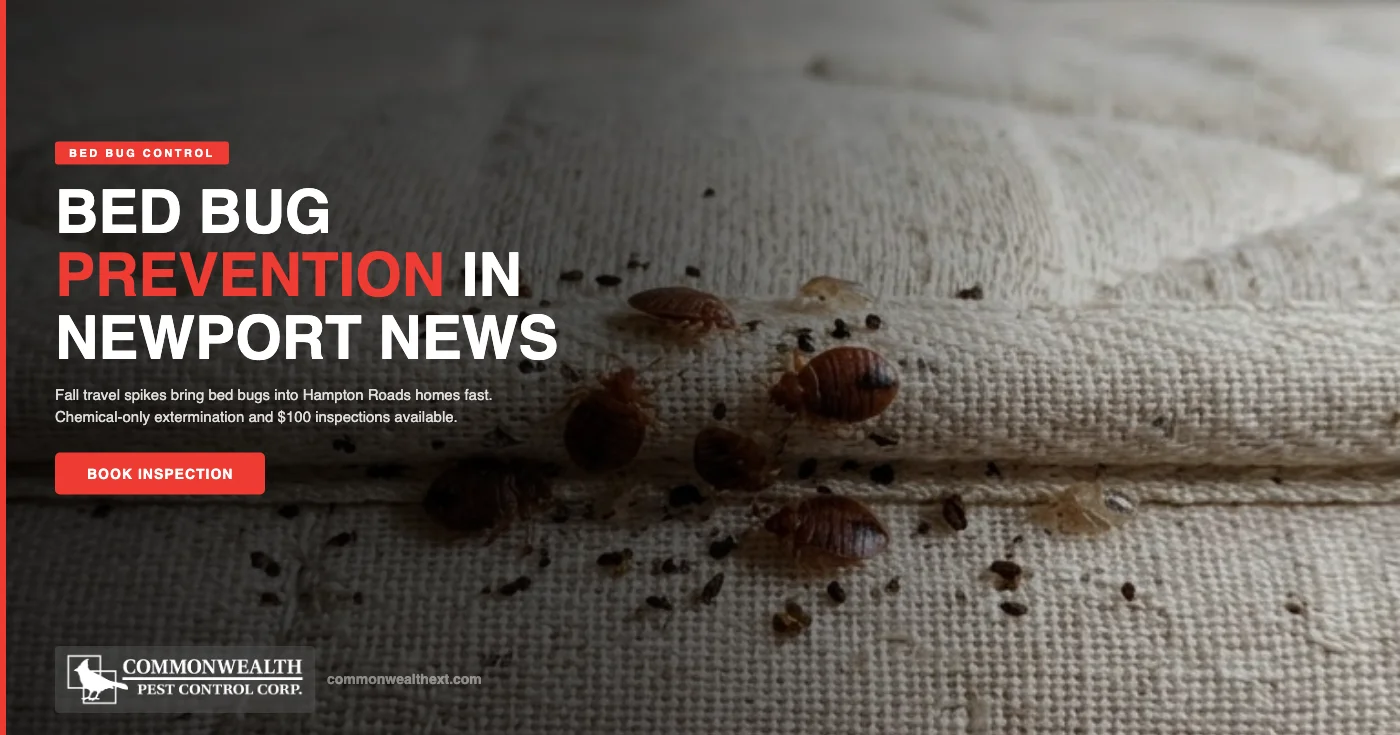
- Dark fecal spotting — pinpoint-size marks that look almost like felt-tip pen dots and bleed into fabric. Check mattress seams, the underside of the box spring, the headboard-wall joint, and inside nearby nightstands. Multiple concentrations usually mean an infestation established for several weeks.
- Shed skins (exuviae) — translucent, hollow casings left behind at each of the five nymph-to-adult molts. Finding multiple exuviae behind a headboard tells us the population has been reproducing on site.
- Live insects — flat, oval, reddish-brown, apple-seed-sized. If you find one, capture it with clear tape, take a photo, and call for an inspection before doing anything else. Searching further on your own can spread bugs into rooms not previously affected.
Why Chemical Treatment Is the Most Effective Bed Bug Solution
Bed bug treatment methods have proliferated in the last decade. Homeowners now hear about heat, freezing, canine detection, encasements, chemical, and various combinations. Across hundreds of Hampton Roads bed bug jobs we've reached a clear conclusion for the vast majority of residential situations: chemical treatment applied by a trained technician on the correct follow-up schedule is the most reliable and cost-effective approach we have — and it's the only method our bed bug control in Newport News, VA relies on.
We don't recommend heat treatment for the homes we work in. Heat requires raising the interior temperature of an entire room — or an entire home — well above 120°F and holding it there for several hours. Achieving that uniformly across a real Newport News home, with insulated wall voids, packed closets, and heat-sensitive electronics, is technically demanding. Cold spots are common, and any harborage that doesn't reach lethal temperature becomes a re-infestation source within days. Heat is also expensive and disruptive, and once the equipment is packed up there is no residual protection against a bug that hatches from a surviving egg the following week.
We also don't recommend "combo" treatments that layer heat and chemical for the same reason we don't recommend heat on its own — the operational complexity introduces failure modes that a clean chemical protocol avoids.
Professional chemical treatment works differently. We apply residual insecticides to the harborage areas where bed bugs actually hide: mattress seams, box spring corners, bed frames, headboards, baseboards, and adjoining furniture joints. These products remain active for weeks, which means any nymph that hatches from an egg during that window still contacts treated surfaces on its way to feed. That residual window is what kills the second and third generation — the generation you can't see when the technician first walks in. Contact insecticides applied to areas of active infestation provide immediate knockdown, and dust formulations reach the wall voids and outlet interiors that liquid products can't. The three product classes work together on a schedule — initial visit plus a follow-up two to three weeks later — designed around the bed bug egg cycle, not single-visit convenience.
What to Expect From a Professional Bed Bug Inspection in Newport News
When a Newport News homeowner calls us about bed bugs, the first step is always a $100 professional inspection — a systematic, room-by-room examination that goes far beyond what a homeowner can do with a flashlight and phone camera.
We start with the sleeping areas, because that's where bed bugs concentrate. Every mattress is examined on top, bottom, and along every seam — including the fabric flap at the head and foot, where a female often deposits eggs. Box springs are inspected on the underside, along the frame edge, and at the corner staples where dust catches. Bed frames, headboards, nightstands, and any upholstered furniture within a few feet of the bed receive the same attention.
From there we widen to secondary harborage: baseboards, interior outlet covers, wall-hanging picture frames, and the seams of curtains and drapes. In older Newport News homes — particularly the pre-1960 stock in Hilton Village and around downtown — we also check pulled-back carpet edges and exposed wood floor gaps. Guest rooms and secondary bedrooms are inspected next, even when the homeowner is confident no one has slept in them recently.
The inspection produces a written assessment. If no evidence is found, you have confirmation that the bites are likely something else — flea, mosquito, or a skin reaction unrelated to insects — and the anxiety of a suspected infestation resolves. If bed bugs are found, the assessment describes what species is present, where evidence was located, how established the infestation appears, and what a properly scoped chemical treatment plan would look like. The $100 fee applies whether or not treatment follows. For families who've hosted, traveled, or brought home secondhand furniture in the last few months and want confirmation before winter travel begins, the $100 bed bug inspection is one of the highest-return calls you can make.
How Commonwealth Pest Eliminates Bed Bugs in Hampton Roads Homes
When treatment is warranted, our bed bug control protocol is straightforward and grounded in the biology of the pest. We schedule the initial application at a time when the home can be vacated for four to six hours by family members and pets. During that window our technician applies residual insecticide to the harborage locations identified in the inspection, contact insecticide to areas of active infestation, and dust to wall voids and outlet interiors.
Preparation matters. Ahead of the visit we walk homeowners through a checklist: launder all bedding, clothing, and washable soft goods on the highest heat setting, place clean items in sealed bags in an untreated room, reduce clutter around the bed, and vacuum mattress surfaces before we arrive. Cutting harborage volume gives the products a better chance of contacting the target and shortens the overall timeline.
After the initial visit the home can be re-occupied once surfaces have dried — typically the same afternoon. Residual products remain effective for weeks, and we specifically instruct families not to wipe down or wash treated surfaces during that window. The follow-up visit two to three weeks later is not optional — it's the visit that addresses newly hatched nymphs that emerged from surviving eggs. Skipping the follow-up is the single most common reason bed bug treatments in Newport News fail to resolve fully. Most residential infestations we handle across Newport News, Hampton, Poquoson, and York County resolve completely after the initial visit and one follow-up; long-established cases sometimes require a third visit, which we discuss transparently with the homeowner.
To learn more, visit our Bed Bug Exterminator page or explore our Pest Control Blog for more Hampton Roads pest guidance. Homeowners who want to understand what to look for before calling can start with the EPA's guide to protecting your home from bed bugs, which covers travel and prevention basics in useful detail.
Commonwealth Pest serves Newport News, Hampton, Poquoson, York County, and the surrounding Hampton Roads communities. Bed bug problems don't resolve themselves — every week a colony continues to grow is a week the treatment gets more involved. If you're seeing signs of bed bugs in your Newport News home, or you want peace of mind after fall travel, the right next step is a $100 professional inspection with Commonwealth Pest this week.