
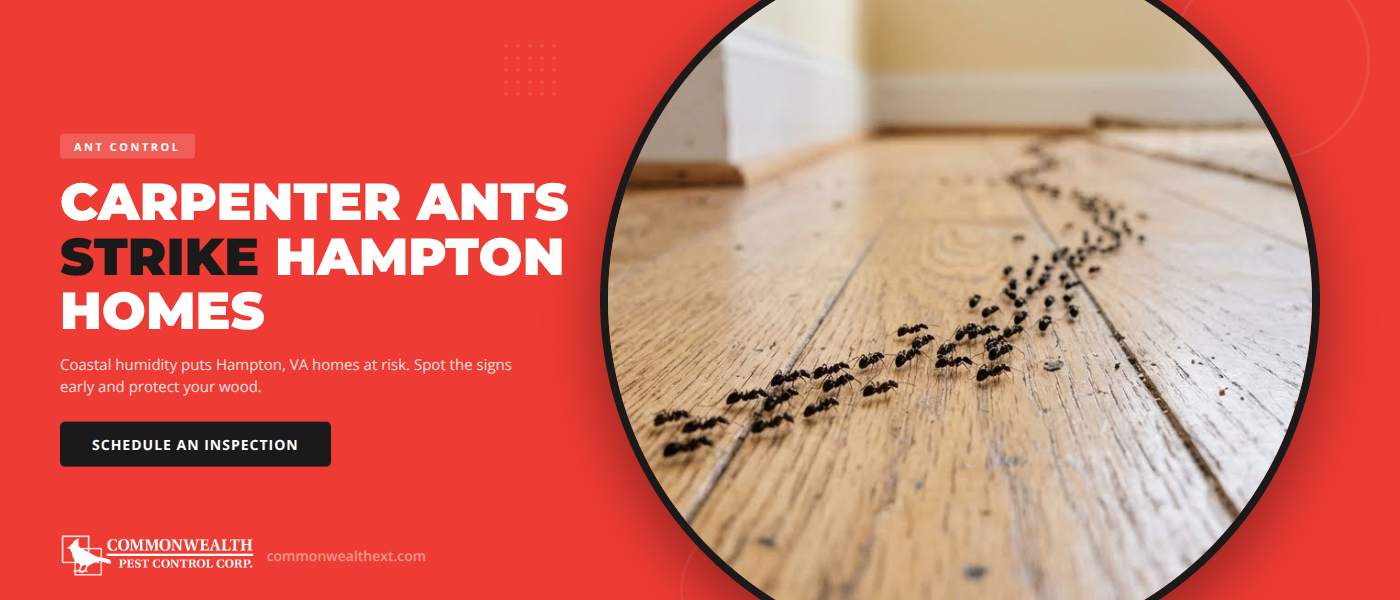
Spring in Hampton, VA brings warmer temperatures, longer days, and one of the most active periods of the year for carpenter ants. As winter humidity gives way to coastal warmth, these large black ants begin searching for moist wood to expand their colonies — and Hampton homes near the water, in older neighborhoods, or with any history of leaks are first on their list. At Commonwealth Pest, our team has treated carpenter ant infestations across Hampton, Newport News, Poquoson, and York County for years, and we know how quickly a small spring colony can turn into a structural concern by midsummer.
This guide walks Hampton homeowners through why carpenter ants thrive here, how to tell them apart from termites, the moisture conditions that attract them, the early signs of an infestation, and how to prevent damage this spring.
Why Hampton, VA's Coastal Climate Is Perfect for Carpenter Ants
Hampton sits on the western shore of the Chesapeake Bay, surrounded by tidal rivers and brackish marshland. That geography produces three conditions carpenter ants love: persistent humidity, soft and water-damaged wood, and mild winters that allow established colonies to survive year after year. While many ant species peak briefly in summer and disappear, carpenter ants stay productive in Hampton from early spring through late fall.
Coastal humidity is the central driver. Air moisture levels in Hampton routinely exceed 70 percent in warmer months, slowing the drying of structural wood and creating microclimates inside crawl spaces, attics, and exterior trim where dampness lingers. Once wood softens, carpenter ants excavate it easily, creating the smooth, hollow galleries where their colonies grow.
Spring rains compound the issue. After heavy rainfall, soil moisture pushes upward into wooden sills, foundation framing, and the bottom edges of decks and porches. Outdoor parent colonies — nesting in tree stumps, firewood piles, or rotting fence posts — send scouts to seek new satellite nesting sites, and any Hampton home with damp wood becomes a candidate. The same wet conditions that drive spring ant infestation Hampton Roads patterns each year also produce the seasonal swarms when winged reproductive carpenter ants leave the parent colony.
How to Tell Carpenter Ants From Termites and Other Ant Species
One of the most common questions our Hampton, VA ant exterminator team gets in spring is whether the insects a homeowner is seeing are carpenter ants, termites, or another species entirely. The distinction matters — treatment plans differ, and confusing the two can let real damage go unaddressed.
Carpenter ants are among the largest ants you will encounter in Hampton homes. Workers measure between one quarter and one half inch long. They are typically jet black, though some species in our area show reddish-brown thoraxes. They have a single visible "node" between thorax and abdomen, a clearly pinched waist, and bent (elbowed) antennae.
Termites by contrast have straight, bead-like antennae, a uniform thick waist with no pinch, and equal-length wing pairs if winged. Subterranean termites in Hampton are pale cream to light brown — much lighter than carpenter ants. Termites also build mud tubes along foundations, something carpenter ants never do.
Other Hampton ants — odorous house ants, pavement ants, little black ants — are much smaller (one sixteenth to one eighth inch) and do not tunnel into structural wood. If the ants you are seeing are noticeably large and dark and active near wood, suspect carpenter ants first. The Virginia Cooperative Extension carpenter ant publication offers a detailed comparison if you want to confirm at home.
Top Moisture Conditions in Hampton Homes That Attract Carpenter Ants
Carpenter ants in Hampton, VA do not damage sound, dry wood. Their colonies need wood that has been softened by water, and Hampton homes offer dozens of opportunities for that to happen. The most common moisture conditions we find during inspections include:
- Crawl space humidity. Vented crawl spaces draw in humid coastal air, and floor joists absorb that moisture until they become long-term carpenter ant habitat.
- Roof and gutter leaks. Slow leaks along roof valleys, around chimneys, or behind clogged gutters wet the wood inside soffits, fascia, and attic eaves — three of the most common carpenter ant nesting locations.
- Window and door frame condensation. Aging windows produce condensation along the lower frame, and over time that moisture rots the sill from the inside out.
- Plumbing leaks under sinks and tubs. A slow drip can soak the cabinet base and adjacent wall studs for months before a homeowner notices.
- Deck and porch posts. Wood-to-soil contact, sprinkler overspray, and mulch piled against posts all keep the lowest section of lumber wet enough for carpenter ants to colonize.
- Firewood and landscape timbers. Firewood stacked against Hampton siding or under an overhang becomes a parent-colony staging point for satellite nests inside the structure.
Resolving these moisture conditions is just as important as treating the ants themselves. We frequently pair our ant treatment with our moisture control service so the underlying conditions are corrected — otherwise a new colony will eventually find the same wet wood.
Early Signs of a Carpenter Ant Infestation Around Your Property
Carpenter ants in Hampton, VA are active mostly at dusk and overnight, which is one reason infestations often grow undetected for months. Knowing where to look — and what to listen for — gives homeowners a real edge.
- Frass piles. Carpenter ants do not eat wood; they tunnel through it and push debris out of small "kick-out" holes. The result is a sawdust-like material called frass, mixed with insect parts. Look for it at the base of trim, near windowsills, around deck posts, and in attic corners.
- Large dark ants indoors after rain. Seeing several large black ants in the kitchen or bathroom following a Hampton spring rain is a strong signal a colony is nesting nearby.
- Faint rustling in walls. Active colonies in stud cavities can produce a quiet rustling sound, particularly in the evening.
- Winged swarmers. In April and May, carpenter ant colonies in Hampton Roads send out winged reproductives. Finding them indoors means a mature colony is already established somewhere in the home.
- Hollow-sounding wood. Tap suspected areas with a screwdriver handle — excavated wood sounds hollow and may flex under light pressure.
- Tiny holes in trim or sheathing. Pinhead-sized exit holes in baseboards, sills, and exterior trim are where workers eject frass.
If you spot any of these signs, document the location with photos before you disturb the area. That helps our technicians find the gallery quickly during the inspection.
How Carpenter Ants Damage Wood Differently Than Termites
Both carpenter ants and termites tunnel through wood, but the patterns they leave behind are very different — and so are the structural risks.
Carpenter ants excavate galleries that look smooth and almost sandpapered, with clean, parallel walls. They prefer wood that is already softened by moisture and tend to avoid sound, dry lumber. Damage usually starts at a moisture point — a leak, a wet sill, a soft deck post — and radiates outward as the colony expands. Because they remove material rather than eat it, you will find frass and debris near the gallery.
Termites by contrast eat the wood and leave behind rougher tunnels packed with mud, soil, and fecal material. Subterranean termites also build characteristic mud tubes on foundations and walls to maintain humidity as they travel between soil and wood. There is no frass — the wood material is consumed.
According to the National Pesticide Information Center, carpenter ants do not eat wood and are slower to cause structural damage than termites — but mature colonies in chronically wet wood can still produce significant repair costs over several seasons. The bigger concern is what an active colony tells us about your home: there is enough water-damaged wood somewhere in the structure to support a full ant colony, and that moisture problem will keep rotting the surrounding framing until corrected.
Yard and Home Prevention Steps Hampton Homeowners Should Take
Most carpenter ant problems in Hampton, VA can be prevented with consistent moisture management and a few exterior habits. We recommend the following each spring:
- Fix every leak quickly. Inspect roof flashing, gutter joints, plumbing connections, and exterior caulking each March. Even small leaks produce enough damp wood for a carpenter ant satellite nest.
- Clean and extend gutters. Keep gutters clear and discharge water at least three feet from the foundation. Standing water against siding is a top driver of carpenter ant activity.
- Improve crawl space ventilation. Many Hampton homes benefit from a vapor barrier or conditioned crawl space upgrade to bring relative humidity below 60 percent.
- Move firewood and mulch. Stack firewood at least 20 feet from the home and elevate it. Pull mulch six inches back from siding and deck posts.
- Trim trees and shrubs. Branches that touch siding or roofing become foraging highways. Maintain 18 inches of clearance.
- Replace soft or damaged wood. Decks, sills, fascia, and trim softened from past leaks should be cut out and replaced — otherwise the conditions that attracted ants remain.
- Schedule a perimeter inspection. An annual exterior check catches new moisture issues before they become carpenter ant habitat.
Homeowners who want a structured plan can pair these steps with our quarterly pest program, which addresses ants alongside other Hampton Roads pests.
When DIY Treatments Fail and It's Time for a Professional
Over-the-counter ant sprays kill the workers a homeowner can see, but they rarely reach the colony itself — and a mature carpenter ant colony in a Hampton home contains 10,000 or more workers across a parent nest and several satellite nests. Spraying the trail does not eliminate the colony, and many topical products cause the colony to "bud," splitting into multiple smaller colonies that scatter across the structure.
The signs that DIY has reached its limit are usually clear: workers reappear within a few days of treatment, frass piles return, swarmers emerge from new locations, or activity moves to a different room. At that point, professional treatment is the more efficient path.
Our ant control service in Hampton, VA is built around colony elimination rather than worker spraying. We locate parent and satellite nests, identify the moisture feeding them, apply non-repellent baits and targeted residuals where the colony actually lives, and follow up to confirm activity has stopped. When moisture is the driver — which it is in nearly every Hampton carpenter ant case — we coordinate moisture control work so the conditions do not return.
How do I tell carpenter ants from termites in Hampton, VA?
Carpenter ants are large (one quarter to one half inch), black or dark, with a clearly pinched waist and bent antennae. Termites are smaller, pale cream to light brown, with a uniform thick waist and straight antennae. Carpenter ants leave frass — termites do not, because they eat the wood.
Why do carpenter ants come back every spring?
Established outdoor parent colonies survive Hampton's mild winters in tree stumps, firewood, and damp landscape wood. Each spring, those colonies send out workers and swarmers to expand into new sites. If your home still has the moisture conditions that attracted them last year, the same colony — or a neighboring one — will return.
What are the signs of carpenter ant damage in coastal homes?
Look for smooth, sandpapered galleries inside softened wood, frass piles at the base of windowsills or deck posts, hollow-sounding trim, and small kick-out holes in baseboards or exterior wood. Damage almost always starts at a moisture point and radiates outward.
Will sealing my home keep carpenter ants out?
Sealing helps, but moisture management matters more. Carpenter ants enter through the smallest gaps — under siding, around plumbing penetrations, through soffit vents — and as long as the home offers wet wood, they will keep finding entry points. Address leaks and humidity first, sealing second.
If you suspect carpenter ants in your Hampton, VA home, our team is ready to help. Explore our ant control service or contact us to schedule an inspection.