
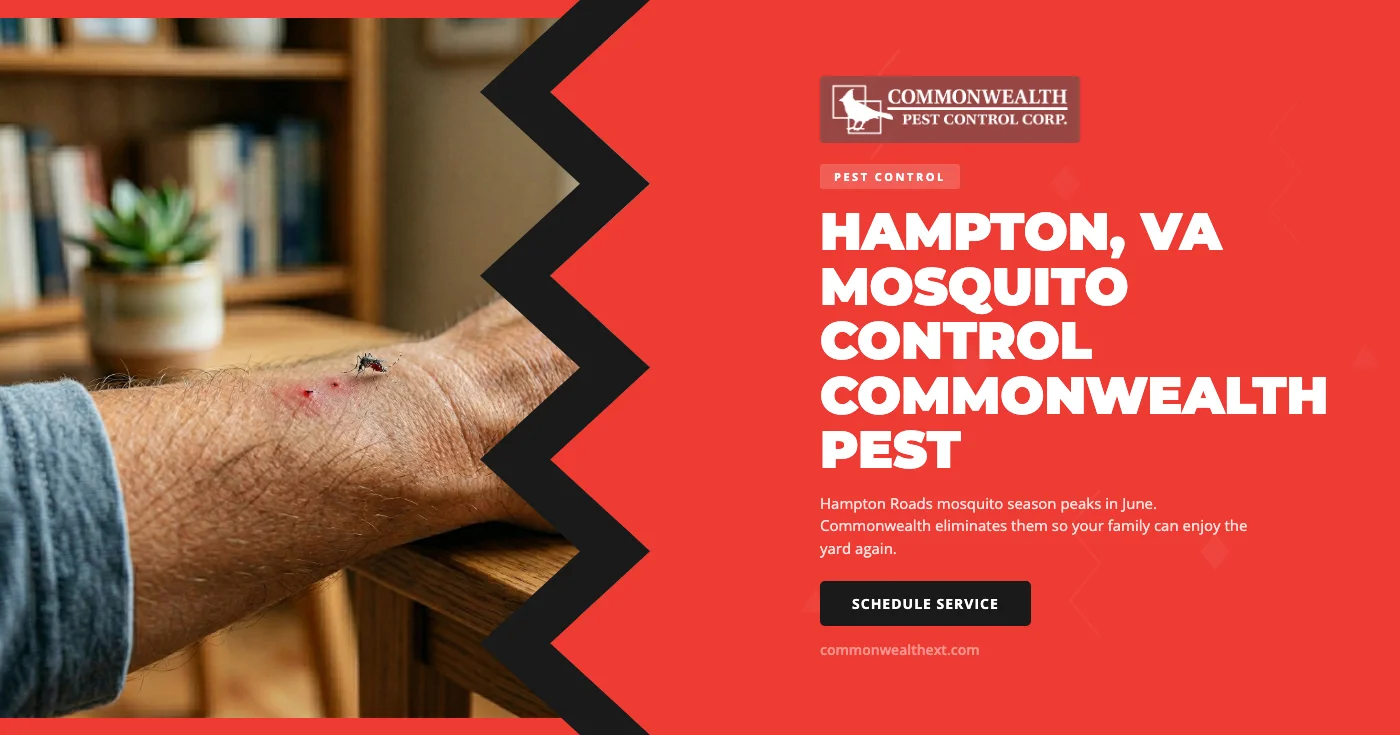
If you live in Hampton, VA, you already know that late June marks the beginning of the most challenging stretch of mosquito season. Temperatures are consistently high, rain events are frequent, and the coastal geography of Hampton Roads creates a humidity environment that mosquitoes thrive in. By the time July arrives, many Hampton homeowners have effectively surrendered their backyards to the swarms — accepting that outdoor evenings just aren't possible until October.
But it doesn't have to be that way. At Commonwealth Pest, we provide professional mosquito control in Hampton, VA and across the Hampton Roads region. We understand the specific conditions that make this area such a productive mosquito environment, and we have the tools and treatment protocols to bring populations under control — so your family can use the yard again. Here's what you need to know about why mosquitoes peak in Hampton in summer, and what actually works to stop them.
Why Hampton, VA Is a Prime Mosquito Habitat in Summer
Hampton occupies a uniquely challenging position when it comes to mosquito pressure. The city sits at the confluence of the James River, Hampton Roads harbor, and the Chesapeake Bay — surrounded by tidal marshes, wetlands, and waterways that create ideal year-round habitat for multiple mosquito species.
Add in summer conditions — sustained temperatures in the upper 80s to low 90s, high relative humidity, and the regular afternoon rain events common to coastal Virginia — and you have a near-perfect environment for mosquito breeding. The Aedes albopictus (Asian tiger mosquito) is particularly prevalent in Hampton and surrounding areas; it's an aggressive daytime biter that breeds readily in the small containers, leaf piles, and water-catching debris found in residential yards.
The tidal nature of Hampton's geography means that standing water isn't limited to residential properties. Drainage channels, roadside ditches, and tidal pools contribute to the regional mosquito population — making it impossible for any single homeowner to eliminate all breeding sources through yard maintenance alone. Professional mosquito control hampton va addresses the residential environment while the broader landscape control is managed at the municipal level.
Late June through August represents peak breeding activity because all of the variables are aligned: water temperature is warm enough for rapid larval development, standing water is abundant from rain events, and adult mosquito lifespans are maximized by the warm temperatures. A female mosquito that would live 2–3 weeks in cooler conditions can live longer and produce more egg batches in Hampton's summer heat.
The Role of Humidity and Coastal Moisture in Mosquito Breeding
Virginia's coastal geography doesn't just provide standing water in the form of marshes and tidal areas — it creates a sustained high-humidity environment that makes residential mosquito problems significantly worse than they would be in a drier inland climate.
Mosquitoes are highly sensitive to dehydration. In dry climates, adult mosquitoes have limited range and must stay close to water sources to survive. In Hampton's humid coastal environment, adult mosquitoes can range much further from their breeding sites — moving freely across neighborhoods and property lines without the moisture constraints that limit populations in drier regions.
High humidity also extends the effectiveness of morning dew and light rain events as a water source. Even a light overnight rain that leaves barely visible moisture on surfaces is enough to provide humidity for resting adult mosquitoes and can refresh small standing water sources — extending the season of standing water availability well beyond individual storm events.
The combination of coastal standing water, high relative humidity, and warm temperatures creates what pest control professionals call a "high-pressure" mosquito environment. In these conditions, reactive control — responding after populations are already high — is significantly harder than proactive treatment that targets mosquitoes before populations build to peak levels. This is why scheduling mosquito treatment hampton virginia in late May or early June, before the peak, produces better results than waiting until July when populations are already established.
Common Mosquito Breeding Spots Around Hampton Homes
Understanding where mosquitoes breed in residential properties is critical to effective control. In Hampton, VA, the most productive breeding sites tend to be small, easy-to-overlook water sources rather than obvious standing water.
Gutters and Downspout Extensions
Sagging gutters with debris buildup are one of the most productive breeding sites on Hampton area properties. Water that pools in a clogged gutter section can persist for weeks, producing continuous breeding activity directly overhead. Low-quality or improperly installed downspout extensions that allow water to pool at the base of the house are another frequent source.
Flat Roofs and Low-Sloped Areas
Homes and structures with flat or low-sloped roofing that retains water after rain events can produce significant mosquito activity that most homeowners never identify because it's above sight lines. If you have a shed, garage, or HVAC equipment enclosure with a flat top, it's worth checking after rain events.
Tarps and Covers
Tarps covering boats, vehicles, firewood, or outdoor furniture are a nearly universal breeding site. They're designed to shed water, but they always have depressions that collect it. A single tarp fold holding a few cups of water is more than adequate for a mosquito breeding cycle.
Ornamental Ponds and Water Gardens
Decorative water features without adequate circulation or biological controls can produce enormous numbers of mosquitoes over the course of a summer. Even a recirculating pump that runs intermittently leaves still zones where breeding can occur.
Children's Play Equipment and Toys
Playsets with slides, swing seats, and connected components often capture and hold rainwater. Children's sandboxes with plastic covers or toys left outdoors are also common sources. These are easy to address once identified but are frequently missed during a basic property inspection.
Low Areas and Drainage Issues
Properties with uneven grading, compacted soil, or inadequate drainage develop recurring puddles after rain events. In Hampton's clay-heavy soils, water absorption is slow — and standing water in yard depressions can persist for 5 to 7 days after a rain event, more than enough time to complete a breeding cycle.
Professional Mosquito Treatment Methods That Work in Virginia
When homeowners ask about the best mosquito control services hampton va has available, the answer depends on the severity of the problem and the specific conditions of the property. Here are the primary professional treatment approaches and when each is most appropriate:
Barrier Spray Programs
Barrier sprays are the backbone of residential mosquito control in Hampton. Treatments are applied to the surfaces where adult mosquitoes rest — foliage, shrubs, vegetation under decks and porches, and shaded ground cover areas. The treatment kills active mosquitoes on contact and provides a protective residual for three to four weeks. For Hampton properties, barrier treatments are most effective on a recurring schedule throughout June, July, and August — with timing adjusted to account for heavy rain events that may reduce residual effectiveness.
Larvicide Applications for Standing Water
Larvicidal treatments applied to water features, standing water sites, and drainage areas target the larval stage before adult mosquitoes develop. Products based on Bacillus thuringiensis israelensis (Bti) or similar biological larvicides are highly effective and safe for fish, birds, and other non-target wildlife. For Hampton properties with ponds, water features, or recurring drainage issues, larvicide is an essential component of a complete treatment program.
Source Reduction Assessment
A professional site inspection identifies breeding sources that homeowners typically miss — clogged gutters, low spots, neglected water features, and water-retaining debris. Correcting source problems at the structural or landscape level provides long-term reduction in breeding habitat that no spray program can fully compensate for. We always combine treatment recommendations with source reduction guidance.
In2Care Mosquito Stations
In2Care stations attract female mosquitoes looking for egg-laying sites, then expose them to a biological larvicide that kills larvae and a fungal agent that the mosquito carries to other water sources she visits. This approach extends control to water sources that can't be directly treated, making it particularly valuable for Hampton properties near wetlands or drainage areas where off-property sources contribute to the local population.
How to Mosquito-Proof Your Hampton Property Between Treatments
Professional treatments work best when homeowners take complementary steps to reduce breeding pressure between scheduled visits. Here's what you can do to make your Hampton yard less hospitable to mosquitoes:
- Walk the property after every rain event and dump standing water. Check every container, depression, cover, and potential water catchment point within 24 hours of a rain event. This single habit eliminates the freshest breeding cohorts before they can develop.
- Clean gutters before mosquito season and after every major storm. Functional gutters that drain freely eliminate one of the most productive residential breeding sites. A spring cleaning before mosquito season and periodic checks after storms keeps them from becoming a problem.
- Add aeration or a pump to decorative water features. Moving water is significantly less attractive to egg-laying females and inhibits larval development. Even a small submersible pump in a bird bath or water garden substantially reduces breeding.
- Trim shrubs and vegetation, particularly around the perimeter and under decks. Adult mosquitoes rest in cool, shaded vegetation during the hottest parts of the day. Keeping vegetation trimmed reduces the resting habitat available and improves the coverage and penetration of barrier spray treatments.
- Store outdoor furniture cushions when not in use. Cushions and fabric outdoor items that are left out can retain moisture in folds and creases — small, easily missed breeding sites that add up over a season.
- Report concerns to your pest control provider before your next scheduled visit. If you notice an unexpected spike in mosquito activity or identify a new potential breeding source, don't wait until the next scheduled appointment. A midcycle spot treatment or source elimination visit can prevent a small problem from compounding.
When to Schedule Mosquito Control for Peak Season in Hampton Roads
Timing matters significantly for mosquito control in Hampton. Here's how to approach the season strategically:
Start before peak season — not after. The most effective time to begin a mosquito control program in Hampton is late April or early May, before populations begin to build. Barrier treatments applied before the season allows protection to be established while mosquito pressure is still low. Starting in July, when populations are already at their height, means you're fighting an established surge rather than preventing one from developing.
Plan for recurring treatments through August. A single treatment provides three to four weeks of residual protection under normal conditions — less after heavy rain events. Season-long protection requires a program of treatments spaced appropriately through the June–August peak period. We work with Hampton homeowners to build a treatment schedule that matches the season's typical rainfall pattern and peak activity windows.
Don't skip treatments after heavy rain. Post-rain periods are when mosquito populations surge most rapidly — fresh breeding cohorts developing from eggs laid in new standing water. Maintaining your treatment schedule (or requesting an additional treatment after a particularly significant rain event) keeps residual protection in place exactly when it's needed most.
Plan around outdoor events. If you have an outdoor event scheduled — a graduation party, backyard cookout, or family gathering — schedule your treatment three to five days in advance. This allows the treatment to fully disperse through the foliage and take effect, providing maximum protection on the day of your event.
Commonwealth Pest provides professional mosquito control in Hampton, VA and throughout the Hampton Roads area. Our recurring treatment programs are designed to keep your yard comfortable through the full summer peak season — so you can be outside with your family without the bites. Contact us to schedule a property inspection or set up your summer treatment program today.