
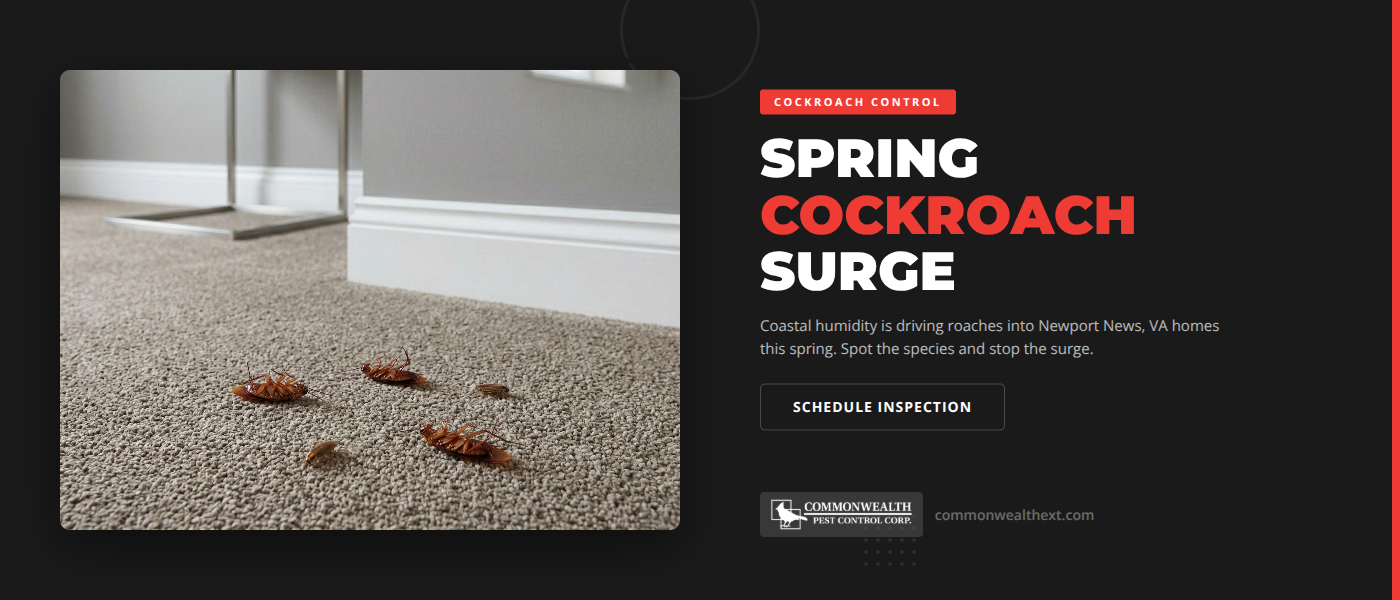
By the time the first warm, sticky weekend hits Newport News, our phones start lighting up with the same question: "Why are we suddenly seeing cockroaches in the kitchen?" The spring cockroach surge happens every year along the Virginia Peninsula. The James River pushes humidity up, daytime temperatures climb out of the 50s, and the roaches that rode out the cool months in crawl spaces and storm drains decide it is time to move in with us. As a cockroach exterminator in Newport News, VA, our team treats this surge every year. This guide walks through why it happens, which species you are dealing with, and what actually works to get them out.
Why Spring Humidity in Newport News, VA Sends Cockroaches Indoors
Newport News sits in a humid subtropical zone, and our springs are unusually wet for the season. Average relative humidity hovers around 75 to 78 percent from March through May, and May is consistently the most humid month of the spring (Weather and Climate). When you combine that moisture with daytime highs that climb from the low 50s in March into the mid 60s and 70s by May, you get the exact conditions cockroaches need to breed and forage.
Roaches are essentially water-driven insects. They can survive surprisingly long stretches without food, but only days without water. During the cool, dry stretch of winter, populations hide in protected microclimates — warm equipment rooms, storm drains, crawl spaces under older Peninsula homes, and the wall voids of multifamily buildings. As soon as outdoor humidity climbs and the soil thaws, those populations expand and start pushing toward any home that offers a steady moisture source. In Newport News, that means almost every kitchen, bathroom, laundry room, and crawl space becomes prime real estate.
If you live near the James River, the Warwick River, or any of the tidal creeks that drain into Hampton Roads, the pressure is even higher. Waterfront soil stays damp longer, and outdoor harborage points stay active well into the cooler months.
American vs. German Cockroaches: Which Species You Are Likely Seeing
Two species cause the vast majority of indoor cockroach calls we run in Newport News, and they behave very differently. Telling them apart matters because the treatment approach is not the same.
German cockroaches are the small ones — about half an inch to five-eighths of an inch long — light tan to brown with two dark parallel stripes running down the shield behind the head (Orkin pest reference). They almost never fly. They are strictly an indoor pest, and they love warm, humid pockets: under the dishwasher, behind the refrigerator, inside cabinet hinges, and around the coffee maker. A single female can produce hundreds of offspring over her lifetime, which is why a few sightings in the kitchen can turn into a full infestation in a matter of weeks.
American cockroaches are the big ones — sometimes called palmetto bugs or water bugs — reaching one and a half to two inches long, reddish brown, with a yellow figure-eight pattern behind the head. They do fly, and they spend most of their lives outdoors in sewers, storm drains, crawl spaces, mulch beds, and tree hollows. In a Newport News spring, we typically see them push indoors through sump pump pits, basement door gaps, garage thresholds, and crawl space vents that are loose or unscreened.
If the roaches you are spotting are small and clustered around food prep areas, we are usually dealing with a German cockroach infestation that is already established indoors. If they are large and seen mostly at night near drains, garage walls, or the laundry room, the source is almost always an outdoor harborage that needs to be treated from the perimeter inward.
Top Hiding Spots Cockroaches Choose in Newport News Homes
When our technicians inspect a Newport News home, we already know which areas to look at first. The hiding spots are remarkably consistent across the homes we service in Hilton Village, Denbigh, Port Warwick, and out toward York County.
- Under and behind the kitchen sink — leaky P-traps and supply lines provide steady water, and the cabinet voids stay warm.
- Inside the dishwasher and refrigerator panels — motor heat plus condensation makes these ideal for German cockroach harborage.
- Behind bathroom vanities and around tub access panels — second-floor bathrooms in older homes are a common surprise spot.
- Crawl space vents and rim joists — older Peninsula homes with vented crawl spaces give American cockroaches a direct path into wall voids.
- Pantries and cabinet hinges — corrugated cardboard food packaging is one of the most overlooked harborage materials in any kitchen.
- Floor drains, washing machine drains, and basement sump pits — direct routes from outdoor sewer systems into the home.
Cockroaches need a crack roughly the thickness of a dime to squeeze through. That means even a tidy, well-maintained home with one neglected gap can host a surprising population.
Health Risks of a Cockroach Infestation for Hampton Roads Families
Cockroaches are not just unsettling — they are a documented health concern, particularly for households with children, asthmatics, or anyone with seasonal allergies. The EPA and the American Lung Association both list cockroach allergens as a leading indoor asthma trigger (American Lung Association). The allergens come from cockroach saliva, droppings, and shed body parts, and they settle into carpet, bedding, and HVAC ductwork where they keep circulating long after the roaches themselves have been controlled.
The numbers are striking. Detectable cockroach allergen has been measured in roughly 63 percent of U.S. homes, and children who are both sensitized and exposed have significantly more wheezing episodes, missed school days, and hospitalizations than children without that exposure. Cockroaches also mechanically transfer bacteria — including Salmonella, E. coli, and other pathogens — from drains and dumpsters onto counters, plates, and stored food.
For Hampton Roads families, the takeaway is that a "small" cockroach problem is rarely actually small. By the time roaches are visible during the day, the population behind the walls is many times larger, and the allergen load in the home is already climbing. Getting ahead of a spring surge is much easier than reversing an established infestation.
Kitchen and Bathroom Cockroach-Proofing Steps That Actually Work
There is real, lasting prevention work you can do in your own home, and it has nothing to do with grocery-store sprays. The goal is to remove the three things every cockroach needs: water, food, and harborage.
- Fix every drip. Repair leaking faucets, supply lines, dishwasher seals, and refrigerator water lines. A slow leak under the sink is the single most common attractant we find in Newport News kitchens.
- Caulk gaps in humid rooms. Use silicone caulk around the kitchen sink, tubs, toilet bases, and the seams where countertops meet walls. Silicone resists mold and moisture, which matters in our climate.
- Run exhaust fans. Use bathroom fans during and after every shower, and use the range hood when cooking. Keeping indoor humidity below 50 percent makes a home dramatically less attractive to roaches.
- Switch to sealed food storage. Glass or hard plastic containers for flour, sugar, cereal, pet food, and pantry staples remove the most accessible food sources.
- Take cardboard out fast. Cardboard boxes are food, water, and harborage all in one. Break them down and remove them the day they come in.
- Seal the perimeter. Weatherstrip exterior doors so a dime cannot slide under, screen crawl space vents, and seal the entry points where pipes, cables, and dryer vents pass through exterior walls.
- Clean under and behind appliances. Grease film behind the stove and crumbs under the toe-kick of cabinets are major German cockroach attractants.
None of these steps alone will eliminate an active infestation, but together they remove the conditions that let one start.
Why DIY Cockroach Sprays Fail in Coastal Newport News
We get this question constantly: "I sprayed three cans of bug killer and the roaches came right back — why?" The answer is well-documented. Most over-the-counter cockroach sprays use pyrethroid-based active ingredients, and field populations of German cockroaches have developed broad resistance to those compounds. A 2024 University of Illinois Extension review of consumer sprays found that mortality on wild, field-collected German cockroaches was below 20 percent after 30 minutes of direct exposure — far short of what is needed to actually control an infestation (University of Illinois Extension).
On top of resistance, sprays only contact the roaches you can see. The actual population — including egg cases, called oothecae — is hidden inside walls, behind appliances, and in cabinet voids. Egg cases are essentially waterproof and largely insecticide-proof, so even a "successful" spray treatment is followed days or weeks later by a fresh hatch from cracks you never reached. Worse, repellent sprays can scatter a colony into new areas of the home, turning a contained kitchen problem into a whole-house problem.
Effective cockroach control in Newport News, VA uses a different toolkit — gel baits, insect growth regulators, targeted dust applications in voids, and follow-up inspections — designed to reach the parts of the population that sprays cannot.
When to Call Commonwealth for Professional Cockroach Treatment
If you have spotted live cockroaches during daylight hours, found dark pepper-like droppings near food prep areas, or noticed a musty, oily odor in cabinets, the infestation is already established and DIY measures are not going to be enough. That is the point where professional cockroach control in Newport News, VA is worth the call.
When you reach out to Commonwealth, we start with a full inspection — kitchen, bathrooms, laundry, crawl space, and exterior perimeter. We confirm the species, locate the harborage points, and build a treatment plan around your specific home, not a one-size template. Our follow-up visits are scheduled around the cockroach life cycle so we hit the next generation as it emerges, not weeks after.
You can read more about our approach on our Cockroach Control page, including what to expect from the first visit, how we protect food prep areas during treatment, and the warranty we stand behind.
Frequently Asked Questions About Cockroaches in Newport News
How long does it take to get rid of a cockroach infestation?
For a typical German cockroach problem in a Newport News home, we usually see meaningful population drop within two weeks and full elimination documented near 90 days of treatment, depending on how widespread the infestation is and how cooperative the home environment is for follow-up work.
Do I need to throw out all my food and dishes before a treatment?
No. Sealed food in glass, hard plastic, or unopened original packaging is fine. We will walk you through which cabinets to clear and how to prep for treatment so the active ingredients reach the right places without contacting food contact surfaces.
Are cockroach treatments gentle around kids and pets?
Yes — we use gel baits and targeted void treatments rather than broadcast sprays, and we design every visit with families and pets in mind. We will explain re-entry timing and any specific room-by-room guidance during the inspection.
Do I really have cockroaches if I have never seen one during the day?
Possibly. Cockroaches are nocturnal, so most homeowners spot droppings, smear marks, egg case fragments, or the musty odor before they ever see a live insect. Any of those signs are worth an inspection, especially during the spring surge.
Can a clean home still get cockroaches?
Yes. Cleanliness reduces the risk but does not eliminate it. American cockroaches enter through plumbing and vents regardless of housekeeping, and German cockroaches frequently arrive in cardboard packaging, secondhand appliances, or shared walls in multifamily housing.
If you are seeing roaches now — or you want to get ahead of the spring surge before they show up — reach out to our team. We know Newport News homes, we know the species we are dealing with, and we know how to clear them out and keep them out.