
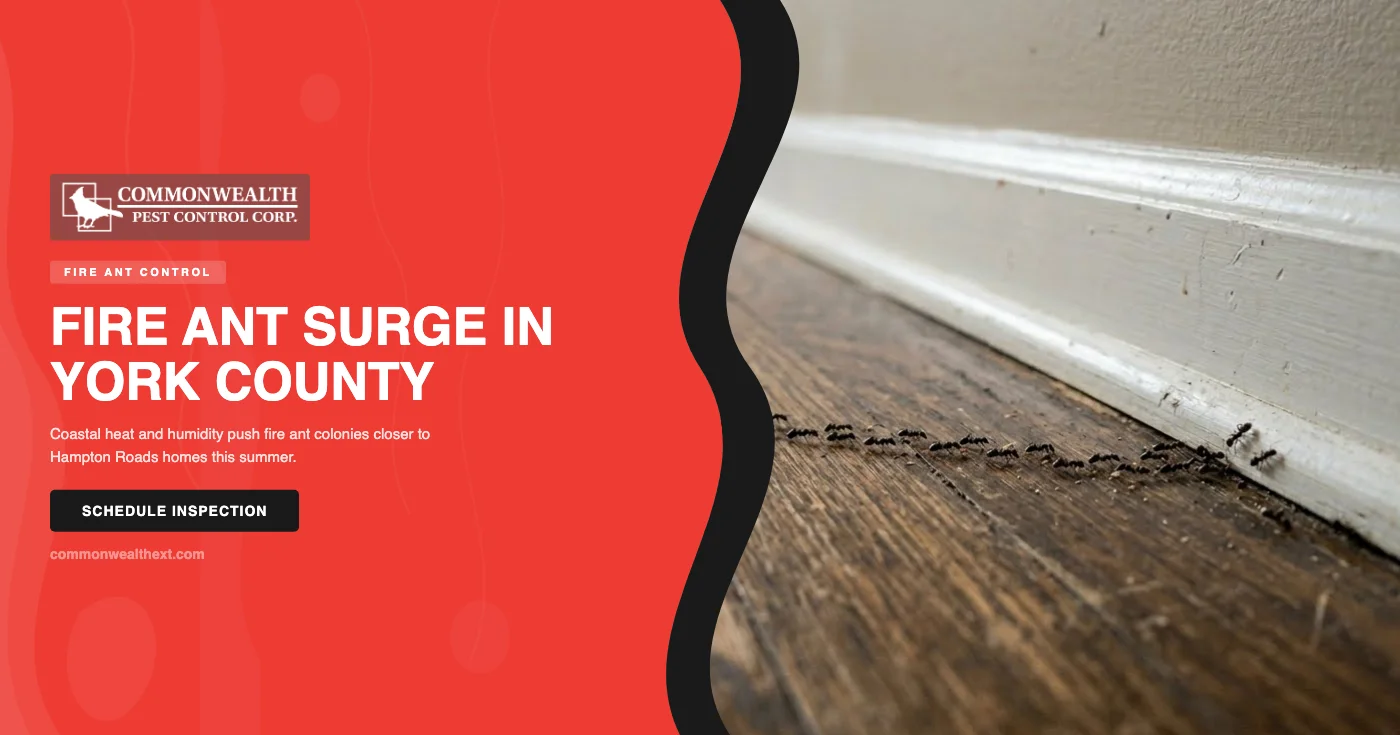
When York County, VA homeowners think of summer pests, the first picture is usually mosquitoes at dusk or wasps along the eaves — not the red, mound-building fire ants that have quietly expanded across the Virginia Peninsula since the federal quarantine reached York County in 2019. But summer phone calls about fire ant control york county va have become a regular part of our week at Commonwealth Pest. Coastal heat, sandy loam soils, and long warm seasons let the red imported fire ant thrive here in ways inland Virginia rarely sees. This guide explains why summer is the worst season for fire ant pressure on York County properties, how to tell fire ants from other coastal Virginia ant species, and what real colony elimination looks like on a Peninsula home.
Why Summer Heat Triggers Fire Ant Activity in York County
Red imported fire ants (Solenopsis invicta) are subtropical in origin, and their biology is tuned to warm soil. When ground temperatures in York County climb into the 80s — typically by mid-June and holding through September — colony growth and foraging accelerate sharply. According to Virginia Tech's Department of Entomology, reproductive flights can occur any time air temperature crosses 72 degrees Fahrenheit, so on the Peninsula new colonies can launch from May through early October.
Summer also brings the conditions fire ants need to expand their footprint. A single mature mound on a York County lawn can contain a quarter million workers and produce winged reproductives that ride storm winds toward fresh ground. After a summer thunderstorm rolls through Tabb, Yorktown, Grafton, or Seaford, we routinely see new satellite mounds appear within days along fence lines, sidewalk seams, and irrigation borders.
Workers also extend their foraging range much farther in hot weather, which is why you can have a colony 40 feet from the back deck and still find ants on the kitchen counter, around pet food bowls, or trailing along the garage threshold.
Identifying Fire Ants vs. Other Common Coastal Virginia Ants
Mistaking another ant species for fire ants — or missing fire ants because they look like another common pest — leads to the wrong treatment plan every time. On a York County property, our technicians use a handful of identifying details to be sure of what we're treating:
- Size and color: Red imported fire ants run 1/16 to 1/4 inch long, with a reddish-brown head and thorax and a darker, almost black abdomen. Workers in the same mound vary in size — a clue, since most other coastal Virginia ants have uniformly sized workers.
- Mound structure: Fire ant mounds are dome-shaped piles of fluffy, granular soil — often a foot in diameter and 6 to 18 inches tall, with no visible central entry hole. Disturb one and hundreds of workers boil up within seconds. Carpenter ant nests, by contrast, are inside wood and produce coarse sawdust kick-out piles, not soil mounds.
- Aggression on contact: Fire ants attack en masse the moment a mound is disturbed and sting repeatedly. Pavement, odorous house, and Argentine ants bite or scatter but don't deliver the burning sting fire ants are named for.
- Mound location: Fire ants prefer open, sunny ground — lawn edges, sidewalk borders, mulch beds, sports fields, septic drain fields, and irrigation borders. They avoid heavily shaded yards, which is why your neighbor on the same street may have mounds when you don't.
Carpenter ants — the other species York County homeowners ask about most — are larger, black or red-and-black, and tied to moisture-damaged wood rather than open soil. They require a different protocol, so getting the identification right at the first inspection is critical.
Health Risks Fire Ant Stings Pose to York County Families
Fire ants bite to anchor themselves, then pivot and inject venom from a stinger at the back of the abdomen, often delivering 5 to 10 stings in a single attack. That mechanism is what makes fire ants a genuine medical concern, not just a yard nuisance.
Within 24 to 48 hours, fire ant stings develop the characteristic fluid-filled pustule that distinguishes them from almost every other insect sting in coastal Virginia. Pustules are intensely itchy, prone to secondary infection if scratched open, and can leave small scars on children with sensitive skin. For most healthy adults, the worst of it is the burning sting and a week of recovery. For sensitized individuals, between 0.5 and 2 percent of people stung will have a systemic reaction — hives across the body, swelling of the lips or throat, dizziness, or full anaphylaxis. Anyone with a known venom allergy on a York County property with active fire ants should keep epinephrine on hand and know how to use it.
Young children, the elderly, and pets are at the highest risk simply because they spend more unsupervised time at ground level. Toddlers stepping into a mound during yard play, dogs investigating a fresh mound face-first, and elderly homeowners checking on garden beds are the three injury patterns we hear about most often during summer service calls in Tabb and Yorktown.
How Coastal Humidity Creates Ideal Fire Ant Habitat
York County sits between the York River, the Chesapeake Bay, and a dense network of creeks and tidal marshes. That geography keeps ground moisture high and soil temperatures moderate through most of the growing season — and red imported fire ants exploit that mix relentlessly.
First, sandy loam soils drain well but stay moist below the surface. Fire ant colonies need consistent soil moisture to keep their brood chambers humid, and the upper coastal plain soils across York County offer exactly that. When inland Virginia clay bakes hard in July, Peninsula yards stay workable — and so do the ants.
Second, landscape irrigation does the work in dry weeks. Lawn sprinklers, drip lines around foundation beds, and pop-up zones along sidewalks keep soil moisture topped off in the exact areas fire ants prefer to mound. We routinely find new mounds along the edge of irrigation patterns within a week of activation.
Third, storm flooding moves colonies onto new ground. Fire ants are famous for forming living rafts during floods, floating until they hit dry land. After a heavy summer storm, an established colony along a low-lying creek can relocate hundreds of yards into a residential neighborhood overnight. Properties that were ant-free in May can host three or four fresh mounds by August on that mechanism alone. Mild York County winters also let mature colonies survive intact, so each year's colony starts the spring already established rather than from scratch.
5 Prevention Steps Every York County Homeowner Should Take
No single homeowner step eliminates fire ants from a Peninsula property — they're too persistent regionally — but the following steps measurably slow new mound establishment and make professional treatment more effective.
- Walk the perimeter weekly between June and September. Fresh mounds are easiest to handle in the first week. Check sidewalk seams, fence lines, mulch bed edges, and the sunny side of foundation plantings. Mark anything suspicious and don't disturb it until treatment.
- Repair leaking outdoor fixtures. Drip irrigation joints, hose bibs, AC condensate lines, and pool equipment overflows create the constant ground moisture fire ants seek. A 15-minute repair often does more long-term good than a month of bait.
- Move firewood, mulch piles, and stone stacks away from the foundation. Fire ants nest under cover as readily as in open ground, and a stack of bagged mulch against the back of the garage gives them a protected launching point.
- Mow at the higher end of your turfgrass range. Taller grass shades the soil surface and makes the lawn less attractive for new colony establishment. Scalped lawns are an open invitation in July and August.
- Don't disturb established mounds. Kicking, raking, or watering a mound triggers defensive swarming and almost always relocates the queen rather than killing her. Mark the mound, keep children and pets clear, and schedule treatment.
Our ant pest control program builds these prevention steps into a homeowner walkthrough at the first visit, so the work we do on the active mounds isn't undone by conditions we never talked about.
When DIY Fire Ant Treatments Fail — and Why
Hardware store fire ant products fall into three buckets — contact-kill drenches, broadcast granular baits, and mound-only treatments — and each one carries a specific failure pattern we see on York County inspections.
Contact-kill drenches work fast on the workers on top of the mound, but the queen is usually 12 to 18 inches below the surface and never contacts the product. The colony loses a thousand workers and replaces them in a week. The homeowner sees ants on day 8 and assumes they came from somewhere new — they didn't.
Broadcast granular baits can kill colonies, but only if the bait is fresh, the timing matches active foraging temperatures, the homeowner doesn't water it in (which deactivates the bait carrier), and coverage is property-wide. Most homeowners spread bait once, see the visible mound stop building, and stop applying — but the satellite colonies they never saw keep producing the next generation.
Mound-only treatments miss the rest of the picture. According to the Virginia Department of Agriculture and Consumer Services, properties inside the quarantine zone are no longer treated by state or federal programs, so regional pressure now relies entirely on private work to contain. Treating one mound while leaving five untreated on the same lot accomplishes little across a summer — especially in York County, where soil, sod, mulch, and nursery stock moved inside the quarantine area can reseed a yard a homeowner just spent two months treating.
Why Commonwealth's Local Ant Control Works for York County Homes
Our fire ant approach for York County is built around three principles. First, full-property inspection comes before any product hits the ground — we map every active mound, every fresh satellite, and every moisture or landscape condition making the property attractive. Second, we treat the colony, not the visible mound, by combining professional-grade broadcast bait timed to active foraging temperatures with targeted mound work where direct elimination is faster. Third, we re-inspect at intervals matched to coastal Virginia summer conditions — typically a follow-up at three weeks, again at six weeks, and a final verification before the school year starts.
For families with quarterly general pest control service already in place, fire ant work folds into the existing schedule rather than billing as a separate program. With consistent professional pressure on the colonies and the moisture and landscape drivers addressed at the homeowner level, York County properties don't have to live with fire ants as a permanent summer reality.
Frequently Asked Questions About Summer Fire Ants in York County
Are fire ants really in York County, or am I dealing with a different species?
Red imported fire ants have been confirmed in York County for years, and York is one of the localities listed under the federal imported fire ant quarantine. If the mound is a granular dome with no central hole and the ants boil up aggressively when disturbed, that's almost certainly a fire ant colony.
How dangerous is a fire ant sting?
For most healthy adults, fire ant stings are painful and form a fluid-filled pustule within 24 to 48 hours that lasts about a week. For the small percentage of people with venom allergies, stings can trigger anaphylaxis — anyone with a known reaction should keep epinephrine accessible and seek medical attention immediately after a sting.
Will one treatment eliminate fire ants from my property?
Rarely. Mature on-property colonies, unnoticed satellites, and regional pressure from the surrounding quarantine zone mean a complete plan usually involves an initial knockdown plus follow-up visits across the summer.
Why does the lawn next door have mounds but mine doesn't — yet?
Fire ants prefer open, sunny ground with consistent soil moisture. Lawn maintenance, irrigation patterns, sun exposure, and landscape clutter all shift the odds. Properties that have escaped so far are still candidates for new mounds after any heavy summer storm.
Can I treat the mounds myself and skip the service call?
You can knock down individual mounds, but the queen usually survives a surface treatment, and any property inside the York County quarantine zone is under constant regional reinfestation pressure.