
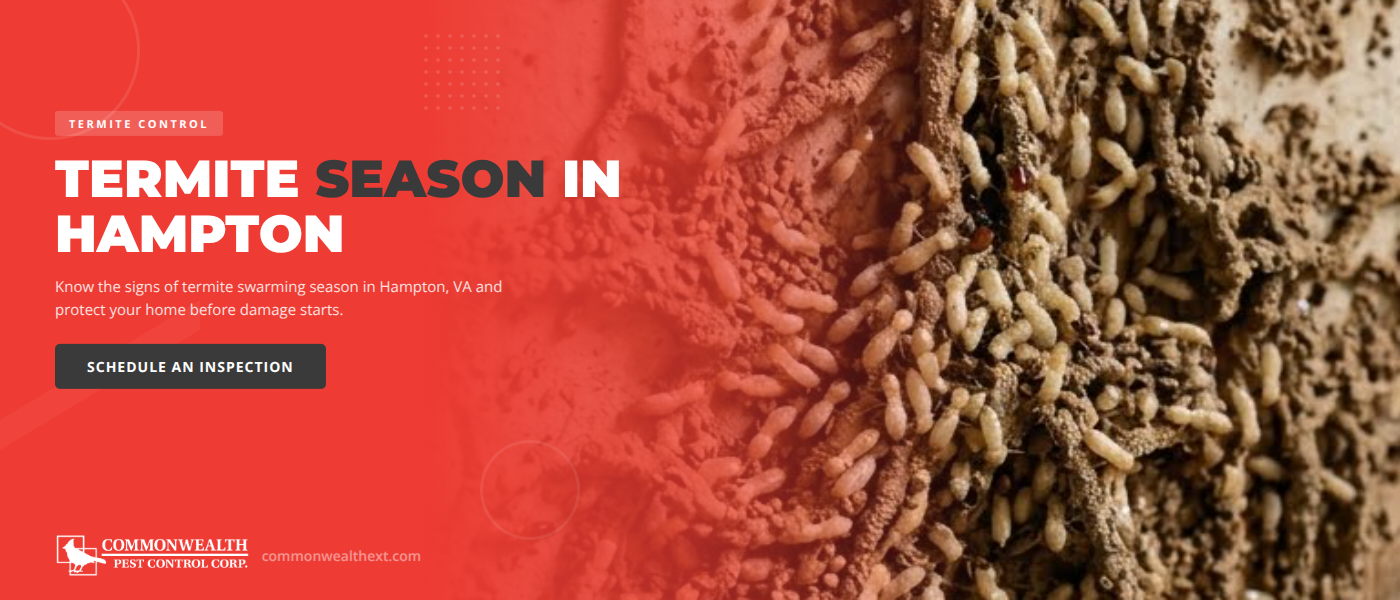
Spring has arrived in Hampton, VA, and with it comes one of the most destructive pest threats homeowners in Hampton Roads face each year: termite swarming season. As temperatures climb and spring rains soak the ground, colonies of subterranean termites send out winged swarmers to establish new nests, and homes across Hampton become prime targets. At Commonwealth Exterminators, we help homeowners throughout the Hampton Roads region identify termite activity early and take action before thousands of dollars in damage occurs. In this guide, we will walk you through everything you need to know about termite season in Hampton, including when it starts, what signs to look for, and how professional treatment can protect your biggest investment.
When Does Termite Season Start in Hampton, VA?
Termite season in Hampton typically begins in late February or early March and extends through May, though activity can start even earlier during unusually warm winters. Subterranean termites, the most common and destructive species in Virginia, swarm when soil temperatures consistently reach the mid-to-upper 60s Fahrenheit and the ground is moist from recent rainfall. In the Hampton Roads region, those conditions often arrive by mid-March, making spring the peak window for new colony formation.
What makes Hampton Roads particularly vulnerable is its combination of warm coastal temperatures, high humidity, and clay-heavy soils that retain moisture. These conditions create an ideal environment for subterranean termites to thrive year-round, but spring is when they become most visible. During a swarm event, hundreds or even thousands of winged reproductive termites emerge from mature colonies, take flight, and pair off to start new colonies. If those new colonies establish themselves near your home's foundation, the damage can begin almost immediately.
It is worth noting that termite colonies do not stop feeding during other seasons. Workers remain active underground throughout the year, silently consuming wood inside your walls, floor joists, and structural beams. Spring swarms are simply the most obvious indicator that termites are present in your area. By the time you see swarmers, the colony that produced them has likely been active for three to five years.
Identifying Termite Swarmers vs. Flying Ants in Hampton
One of the most common mistakes homeowners make during spring is confusing termite swarmers with flying ants. Both insects emerge around the same time, both have wings, and both tend to appear near windows and light sources. However, there are clear physical differences that can help you tell them apart.
Termite swarmers have straight, beaded antennae, a thick waist with no visible constriction between the thorax and abdomen, and two pairs of wings that are equal in length. Flying ants, on the other hand, have elbowed antennae, a pinched waist, and front wings that are noticeably longer than the hind wings. Termite swarmers are also typically uniform in color, ranging from dark brown to black, while flying ants may vary in color depending on the species.
If you find winged insects inside your Hampton home, especially near windowsills, light fixtures, or basement areas, collect a few in a sealed bag and contact us for identification. We provide free termite inspections and can quickly determine whether you are dealing with termites or a less destructive pest. Correctly identifying the insect is the critical first step in protecting your property.
Warning Signs of Termite Activity in Your Hampton, VA Home
While swarmers are the most dramatic sign of termite presence, they are far from the only indicator. Learning to recognize the subtle signs of an active infestation can save you significant repair costs. Here are the key warning signs every Hampton homeowner should watch for during spring and throughout the year.
Mud tubes on foundation walls. Subterranean termites build pencil-sized tubes made of soil, saliva, and wood particles to travel between their underground colony and the wood they are feeding on. These tubes are most commonly found along foundation walls, in crawl spaces, on support piers, and along plumbing penetrations. If you spot mud tubes on your property, it is a strong indication that termites have already established a pathway into your home.
Discarded wings near windows and doors. After a swarm, termite reproductives shed their wings once they land and pair up. Finding piles of small, translucent wings on windowsills, near door frames, or in spider webs around your home's exterior is a reliable sign that a swarm has occurred nearby. Even if you did not witness the swarm itself, shed wings confirm that termites are actively colonizing in your area.
Hollow-sounding or damaged wood. Termites consume wood from the inside out, leaving a thin outer shell that may appear normal on the surface. Tapping on baseboards, door frames, window trim, and other wood elements with a screwdriver handle can reveal hollow-sounding areas where termites have been feeding. You may also notice wood that appears blistered, sagging, or that crumbles easily when probed.
Frass or termite droppings. While subterranean termites typically push their waste into their mud tubes, drywood termites leave behind small pellets called frass that resemble sawdust or coffee grounds. Finding frass near wooden structures or along baseboards warrants an immediate professional inspection.
Doors and windows that stick. As termites consume the wood around door frames and window casings, structural integrity weakens, causing warping and misalignment. If doors or windows that previously operated smoothly suddenly become difficult to open or close, termite damage may be the cause.
Why Hampton Roads Homes Are at Higher Risk for Termite Damage
Hampton Roads sits in one of the highest termite pressure zones in the United States. The region's geographic and climatic characteristics create conditions that are nearly perfect for subterranean termite colonies to flourish. Understanding why your Hampton home faces elevated risk can help you make informed decisions about prevention and treatment.
The coastal mid-Atlantic climate delivers warm temperatures for much of the year, with humidity levels that keep soil consistently moist. Subterranean termites require moisture to survive, and the water table in many parts of Hampton sits close to the surface. Older neighborhoods with mature landscaping, wooden fences, and established tree root systems offer abundant food sources and sheltered pathways for colonies to expand toward homes.
Many homes in Hampton were built decades ago using construction methods that did not account for modern termite prevention standards. Older homes may have wood framing in direct contact with soil, inadequate crawl space ventilation that promotes moisture accumulation, and aging foundation seals that create easy entry points. Even newer construction can be vulnerable if grading directs water toward the foundation or if mulch is stacked against exterior walls.
The density of termite colonies in Hampton Roads means that even homes with no previous history of problems can develop infestations quickly. Neighboring colonies send out swarmers every spring, and it only takes one successful pair to establish a new colony targeting your property. Proactive prevention and regular inspections are essential for homeowners in this area.
Professional Termite Treatment Options
When it comes to eliminating termites and preventing future infestations, professional treatment is the only reliable approach. Over-the-counter sprays and DIY bait stations may kill a few visible termites, but they rarely reach the underground colony where the queen continues producing thousands of new workers. At Commonwealth Exterminators, we offer termite treatment solutions tailored to Hampton Roads properties.
Liquid barrier treatments involve applying a termiticide around and beneath your home's foundation, creating a continuous chemical barrier that termites cannot cross without being exposed to the treatment. Modern liquid treatments are odorless, long-lasting, and designed to be transferred between termites through contact, meaning workers carry the product back to the colony where it eliminates the queen and the rest of the population over time.
Bait station systems use strategically placed in-ground stations around your property's perimeter. These stations contain a cellulose-based bait that termites prefer over natural wood. Workers feed on the bait and share it with the colony, including the queen, resulting in colony elimination. Bait systems also serve as a long-term monitoring tool, alerting us to new termite activity before it reaches your home.
Comprehensive inspections are the foundation of every effective termite management program. Our licensed technicians examine your home's interior and exterior, including crawl spaces, attics, foundation walls, and all wood-to-soil contact points. We use moisture meters and decades of field experience to detect activity that may not be visible to the untrained eye.
Termite Prevention Tips for Hampton Homeowners
While professional treatment provides the strongest line of defense, there are several steps you can take to reduce your home's attractiveness to termites and catch problems early.
Eliminate wood-to-soil contact. Ensure that wooden siding, deck posts, porch steps, and other structural elements do not make direct contact with the ground. Maintain at least six inches of clearance between soil and any wood components of your home. Use concrete or metal supports where posts or beams meet the ground.
Manage moisture around your foundation. Direct gutters and downspouts to carry water at least three feet away from your foundation. Repair any leaking faucets, pipes, or AC units that create damp conditions near your home. Ensure crawl spaces are properly ventilated and consider installing a vapor barrier.
Keep mulch and debris away from your home. Mulch retains moisture and provides a food source for termites. If you use mulch near your foundation, keep it at least twelve inches away from exterior walls and limit depth to two inches. Remove dead stumps, fallen branches, and stored firewood from areas adjacent to your home.
Seal entry points. Fill cracks in your foundation, seal gaps around utility penetrations, and repair any damaged mortar joints. While these measures will not stop a determined colony, they can slow the rate at which termites gain access to your home's structural wood.
Schedule annual inspections. Even with an active treatment plan, annual professional inspections are critical for catching new activity early. We recommend inspections in late winter or early spring, just before peak swarming season, so developing problems can be addressed before they escalate.
Frequently Asked Questions About Termite Season in Hampton, VA
How long does termite season last in Hampton?
Termite swarming season in Hampton typically runs from late February through May, with the heaviest activity occurring in March and April when warm rains are most frequent. However, termite colonies remain active and continue feeding on wood structures year-round, regardless of whether swarms are visible.
Can termites damage a home in Hampton during winter?
Yes. While swarms do not occur during colder months, worker termites remain active underground and continue feeding throughout the winter. The relatively mild winters in Hampton Roads mean that soil temperatures rarely drop low enough to slow termite activity significantly.
How much damage can termites cause before we notice?
Termite colonies can feed undetected for three to five years or longer. By the time visible signs appear, the colony may have consumed significant amounts of structural wood. Industry estimates suggest that termite damage costs U.S. homeowners billions of dollars annually, and most homeowners insurance policies do not cover termite damage because it is considered preventable through regular maintenance and inspections.
Do we need a termite bond when selling a home in Hampton, VA?
While Virginia law does not require a termite bond for home sales, most lenders and buyers in the Hampton Roads market expect a current termite inspection report, and many require an active treatment plan or bond as a condition of closing. Having a termite bond in place can also increase buyer confidence and streamline the selling process.
Protect Your Hampton Home This Spring
Termite season in Hampton, VA is already underway, and every week of delay gives colonies more time to establish themselves and begin damaging your home. Whether you have spotted swarmers, found mud tubes, or simply want the peace of mind that comes with a professional inspection, our team is ready to help. We have been serving homeowners and businesses across Hampton Roads with reliable, effective pest control services, and we bring that same commitment to every termite inspection and treatment we perform. Contact Commonwealth Exterminators today to schedule your inspection and take the first step toward protecting your property from one of Hampton Roads' most persistent and costly pests.