
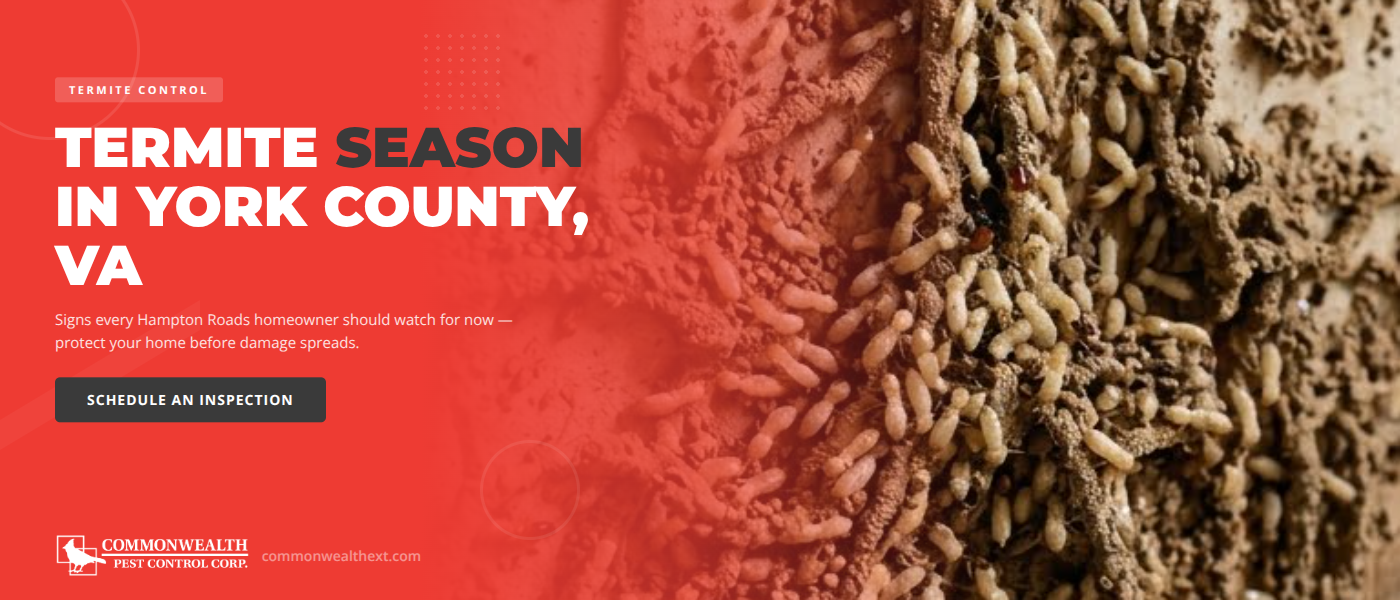
Every spring, homeowners across Hampton Roads brace for one of the most damaging pest events of the year: termite swarming season. If you live in York County, VA, the combination of warm temperatures, coastal humidity, and aging housing stock puts your property at elevated risk for termite damage. At Commonwealth Pest, we have been helping families throughout the Hampton Roads region protect their homes from termites, and we want to make sure you know exactly when termite season hits, what the warning signs look like, and what you can do to stay ahead of the problem.
When Does Termite Season Start in York County, VA?
Termite season in York County and the broader Hampton Roads area typically begins in early spring, often as early as late February or March, and can extend through early summer. The exact timing varies from year to year based on weather conditions, but the pattern is consistent: when soil temperatures warm and humidity rises after spring rains, subterranean termite colonies send out swarmers to establish new colonies.
In 2026, pest professionals across Hampton Roads are reporting earlier-than-usual termite activity. The ground has been warming faster this year, and termite colonies are reaching peak energy levels ahead of schedule. For homeowners in York County, this means the window for proactive inspection and treatment is narrower than usual. Waiting until you see a swarm often means the structural damage has already been underway for months or even years.
Subterranean termites, which are the most common species in Virginia, typically swarm during the day after warm, humid weather or following a spring rain. You are most likely to notice swarmers between March and May, though activity can continue into June depending on conditions. Formosan termites, sometimes called super termites because of their massive colony sizes and aggressive feeding behavior, also have a presence in the Hampton Roads coastal corridor and tend to swarm slightly later in the season.
Why York County, VA Is Especially Vulnerable to Termite Damage
Several factors make York County and the surrounding Hampton Roads communities particularly susceptible to termite infestations. Understanding these risk factors can help you take more targeted preventive action.
Coastal Humidity
York County sits in one of the most humid regions of Virginia. The proximity to the Chesapeake Bay and the York River creates consistently high moisture levels in the air and soil. Subterranean termites thrive in moist environments because they need constant access to water. The damp soil conditions throughout Hampton Roads provide ideal habitat for termite colonies to grow and expand year after year.
Older Housing Stock
Many homes in York County were built decades ago, and older construction methods did not always include the termite-resistant barriers and treatments that modern building codes require. Wooden subfloor structures, untreated lumber in crawl spaces, and older foundation designs can provide easy access for subterranean termites moving from the soil into your home. Even homes with concrete slab foundations are not immune, as termites can enter through expansion joints, plumbing penetrations, and hairline cracks.
Wooded Surroundings
York County's heavily wooded landscape provides abundant natural food sources for termite colonies. While termites prefer to feed on dead wood, fallen trees, and decaying organic matter in forests and yards, colonies that establish themselves near residential properties will readily extend their foraging tunnels toward homes and outbuildings when they detect moisture and wood nearby.
Warning Signs of Termite Activity in Your York County, VA Home
Termites are often called silent destroyers because they can cause extensive damage before homeowners ever notice their presence. Knowing what to look for can mean the difference between catching an infestation early and facing thousands of dollars in structural repairs.
Mud Tubes
Subterranean termites build pencil-sized tubes made of soil, wood particles, and saliva along foundation walls, support piers, floor joists, and other surfaces. These mud tubes serve as protected pathways that allow termites to travel between the soil and the wood they are feeding on while maintaining the moisture they need to survive. Check your foundation walls, crawl space supports, and any exposed wood in your basement regularly for these telltale tubes.
Shed Wings
After termite swarmers land and pair off to start new colonies, they shed their wings. Finding small, translucent wings on windowsills, near light fixtures, around doors, or near HVAC vents is one of the most common early indicators of termite activity. Swarmers are attracted to light, so wings found near windows and exterior lighting are especially telling.
Hollow-Sounding Wood
Termites consume wood from the inside out, leaving a thin shell of intact wood on the surface while hollowing out the interior. Tap on door frames, baseboards, window trim, and any wood near the ground level. If it sounds hollow or papery, termites may have already been feeding on the interior structure. Pay particular attention to areas where wood contacts or is close to soil, as these are the most common starting points for subterranean termite damage.
Buckling or Sagging Floors
Advanced termite damage can cause floors to warp, buckle, or develop soft spots. If you notice any areas where the floor feels spongy underfoot or appears to be sagging, it could indicate significant structural damage beneath the surface. This is especially common in homes with wooden subfloor structures over crawl spaces.
Frass and Droppings
While subterranean termites typically do not leave visible droppings, drywood termites produce small, pellet-shaped droppings called frass. These resemble fine sawdust or sand and are often found in small piles near infested wood. Although drywood termites are less common in York County than subterranean species, they can still be present in homes, particularly in attic spaces and upper-story wood framing.
Termites vs. Flying Ants - How to Tell the Difference in York County, VA
Spring swarming season in Hampton Roads brings out both termite swarmers and flying ants, and many homeowners confuse the two. Proper identification is critical because the treatment approaches are completely different.
Termite swarmers have a straight, thick waist with a tube-like body shape, and their front and back wings are roughly equal in length. Flying ants, by contrast, have a distinctly pinched waist that gives them an hourglass appearance, and their front wings are noticeably larger than their hind wings. Termite wings also break off easily, which is why you often find piles of shed wings but no insects nearby.
If you are unsure which pest you are seeing, collecting a sample in a sealed bag or taking a clear photo can help our team identify the species quickly and recommend the right course of action.
How We Protect York County, VA Homes From Termite Damage
At Commonwealth Pest, we take a comprehensive approach to termite protection that goes beyond simply treating visible infestations. Our process is designed to identify existing damage, eliminate active colonies, and create lasting barriers that protect your home for years to come.
Thorough Inspection
Every termite service begins with a detailed inspection of your property, including the interior, exterior, crawl space, and any outbuildings. We check for mud tubes, wood damage, moisture conditions, and entry points that could allow termites to access your home. We also evaluate environmental factors like drainage, soil contact with wood, and landscaping that may be contributing to termite risk.
Targeted Treatment
Based on our inspection findings, we develop a customized treatment plan that addresses your specific situation. For active subterranean termite infestations, we use liquid termiticide barriers around the foundation and direct treatment of affected areas. Baiting systems may also be used to eliminate entire colonies by targeting the queen and worker termites at the source.
Ongoing Monitoring
Termite protection is not a one-time event. We recommend annual inspections to catch any new activity early and ensure your treatment barriers remain effective. Many homeowners in York County also benefit from termite bonds, which provide ongoing coverage and regular monitoring to protect your investment.
Preventive Steps Every York County, VA Homeowner Should Take
In addition to professional treatment, there are several steps you can take to reduce your home's appeal to termites and make it harder for them to gain access.
- Eliminate wood-to-soil contact: Ensure that siding, door frames, and deck posts do not directly touch the ground. Use concrete or metal supports to create a gap between wood and soil.
- Manage moisture: Fix leaky pipes, ensure gutters drain away from the foundation, and address any standing water in crawl spaces. Proper ventilation in crawl spaces is essential for reducing the humidity that termites need.
- Store firewood away from your home: Keep firewood, lumber, and other wood materials at least 20 feet from your house and elevated off the ground.
- Remove dead wood and debris: Clear fallen branches, tree stumps, and decaying wood from your yard. These provide food sources that can sustain termite colonies near your home.
- Seal entry points: Caulk cracks in your foundation, seal gaps around utility penetrations, and repair damaged weather stripping around doors and windows.
- Schedule annual inspections: Even if you do not see signs of termites, annual professional inspections can detect activity that is invisible to the untrained eye.
Frequently Asked Questions About Termite Season in York County, VA
When is termite swarming season in York County, VA?
Termite swarming season in York County typically runs from March through May, though it can start as early as late February in warmer years. Subterranean termites usually swarm during the day after warm spring rains. In 2026, activity has been reported earlier than usual across Hampton Roads due to warmer soil temperatures. Formosan termites, which are also present in the coastal Hampton Roads corridor, tend to swarm later, from late spring into early summer.
How much damage can termites cause to a York County, VA home?
Termites cause billions of dollars in property damage across the United States each year, and Hampton Roads is one of the highest-risk regions on the East Coast. A mature subterranean termite colony can contain hundreds of thousands of workers, and Formosan termite colonies can number in the millions. Left untreated, termites can compromise floor joists, support beams, wall framing, and other critical structural components. Most homeowner insurance policies do not cover termite damage, making prevention and early detection essential.
Can I treat termites myself in York County, VA?
While there are retail termite products available, DIY treatments are rarely effective against established colonies. Subterranean termites nest underground and can have foraging tunnels that extend hundreds of feet from the main colony. Effectively treating an infestation requires professional-grade products, specialized equipment, and knowledge of termite biology and behavior. We strongly recommend professional inspection and treatment to ensure complete colony elimination and ongoing protection.
Do I need a termite bond when selling my home in York County, VA?
In Virginia, most real estate transactions require a Wood-Destroying Insect Report as part of the closing process. A termite bond provides ongoing termite protection and regular inspections, which can be attractive to buyers and may be required by certain lenders. Having an active termite bond in place demonstrates that your home has been professionally inspected and treated, which can facilitate a smoother real estate transaction.
What is the difference between subterranean and drywood termites in York County, VA?
Subterranean termites are by far the most common species in York County and throughout Hampton Roads. They nest in the soil and build mud tubes to access wood above ground. Drywood termites, while less common in this area, can infest wood directly without needing soil contact. They typically target attic framing, window frames, and furniture. Each species requires different treatment approaches, which is why professional identification is an important first step.
Protect Your York County, VA Home Before Termite Season Peaks
Termite season in York County, VA is already underway, and conditions are shaping up for an especially active year. Do not wait until you see a swarm or discover damage to take action. Early inspection and proactive treatment are the most effective ways to protect your home and avoid costly repairs.
Our team at Commonwealth Pest is ready to help you assess your risk, treat any existing activity, and establish ongoing protection for your property. Contact us today to schedule your termite inspection and get ahead of termite season in York County and throughout Hampton Roads.