
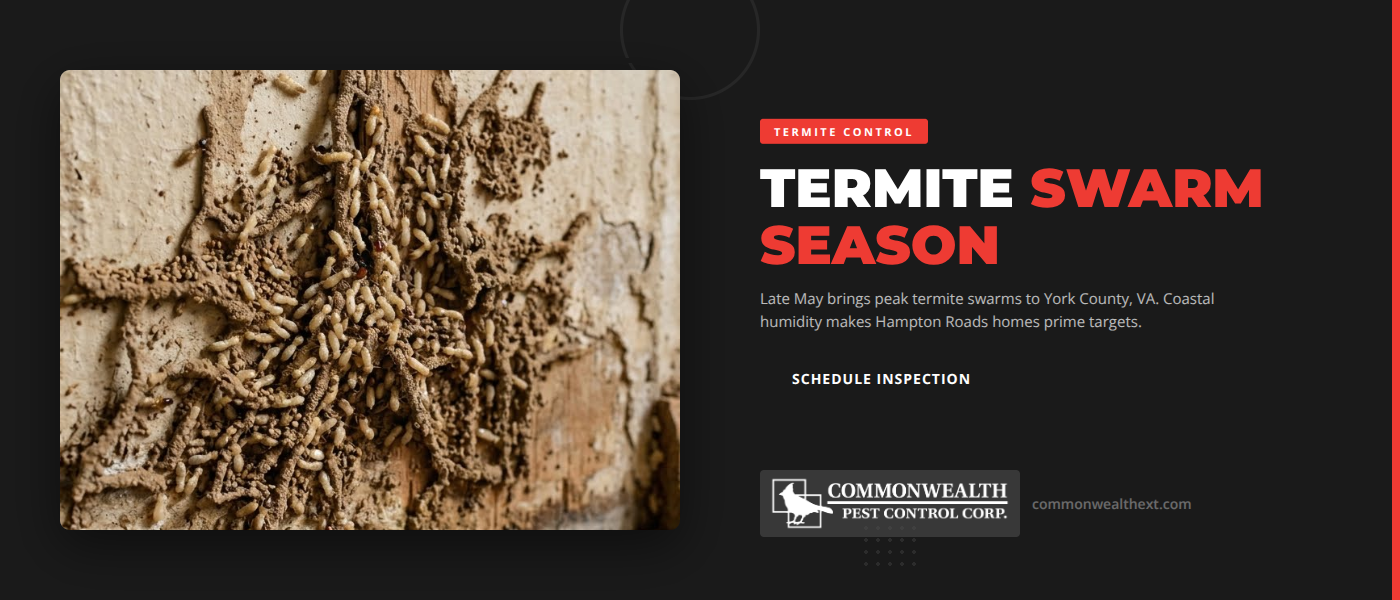
Every spring, the same scene plays out across York County, VA. A homeowner walks into the kitchen and finds a pile of translucent wings on the windowsill — or a cloud of dark, half-inch insects boiling out of a porch column. That is termite swarm season, and along the Virginia Peninsula it peaks in late May. Our team treats subterranean infestations across York County, Hampton, and Newport News every spring. This guide walks through why coastal humidity makes our area such a target, how to tell a termite swarmer from a flying ant, and what protection looks like once a swarm appears.
Why Late May Is Peak Termite Swarm Season in York County, VA
Eastern subterranean termites — the species responsible for almost every infestation we treat across Hampton Roads — swarm when the soil warms into the high 60s and the air carries enough moisture to keep the swarmers' wings from drying out before they can pair up and dig back in. In coastal Virginia, that window opens in mid to late April and reaches its peak the last two weeks of May. By the first week of June, most colonies have finished their primary swarm flight for the year.
The trigger is usually a warm afternoon following a soaking rain. Mature colonies — typically five to seven years old — release thousands of winged reproductives at once. Most die within hours. The pairs that survive find soil contact within a few feet of where they landed, shed their wings, and start the next colony on the spot. That is why finding swarmers indoors or against your foundation matters — it means a colony is either already underneath the structure or close enough to threaten it.
York County's older neighborhoods around Yorktown, newer construction in Tabb and Grafton, and waterfront properties along the York River all sit on the warm, damp soils subterranean termites prefer. The species does not care whether your home is 200 years old or 20 — it cares whether there is wood, moisture, and soil contact.
How Coastal Humidity in Hampton Roads Fuels Subterranean Termite Activity
Subterranean termites cannot tolerate dehydration. Their bodies are roughly 75 percent water, and a worker exposed to open air for more than a few hours will die. That fact explains why the Virginia Peninsula is one of the most active termite zones on the East Coast.
York County sits in a humid subtropical climate. Average relative humidity stays between 70 and 80 percent from April through October (Weather and Climate data). Proximity to the York River, the Chesapeake Bay, and the tidal creeks that drain the lower Peninsula keeps groundwater high. That combination lets subterranean colonies expand foraging tubes from the soil up into siding, sill plates, and structural framing without losing moisture along the way.
The U.S. Forest Service maps the entire coastal plain of Virginia in the "heavy" termite damage probability zone — the highest classification on the federal TIP (Termite Infestation Probability) map (USDA Forest Service termite hazard map). That rating is the reason Virginia building code requires termite protection on all new residential construction in our region.
The practical impact in York County: colonies that take eight to ten years to mature in drier inland states reach swarm-producing maturity here in five to seven. A mature colony can sustain 60,000 to 1,000,000 termites and consume roughly a pound of wood per week — quietly, behind drywall and beneath subflooring, for years before any visible damage appears.
Swarmers vs. Flying Ants: How York County Homeowners Can Tell the Difference
This is the single most common call we get during swarm season — "We have winged bugs everywhere, are these termites?" Carpenter ants and other ant species also produce winged reproductives in spring, and at a glance the two look similar. The difference matters because one means a structural pest problem and the other usually does not.
Three quick checks tell them apart (Virginia Tech Cooperative Extension termite identification):
- Waist. Termite swarmers have a thick, straight body — no defined waist. Flying ants have an obvious pinched waist between the thorax and abdomen.
- Antennae. Termite antennae are straight and beaded. Ant antennae are elbowed, bending sharply about halfway down.
- Wings. Termite swarmers have four wings that are all the same length and noticeably longer than the body — usually translucent or milky. Flying ants have four wings with the front pair clearly larger than the back pair.
One practical clue: termite wings detach very easily. Piles of identical translucent wings on a windowsill, in a window well, or trapped in a spider web near the foundation are almost always termite evidence — even if the swarmers themselves are gone. Save a few in a small bag and we can confirm the species during inspection.
Early Warning Signs of a Termite Infestation in Your Home
Swarmers are the loudest signal, but they are not the only one. Subterranean termites leave a trail of subtle evidence around York County homes long before any wood fails. The earlier these signs are caught, the smaller the repair bill.
- Mud tubes. Pencil-width tunnels of dirt and saliva running up foundation walls, crawl space piers, brick veneer, or sill plates. These are the highways termites build to keep their humidity around them while traveling between soil and wood.
- Hollow-sounding wood. Tap baseboards, door frames, window sills, deck posts, and porch columns with a screwdriver handle. Termite-damaged wood sounds papery or hollow.
- Blistered or peeling paint. Termites eat the inside of trim and siding, leaving a thin painted shell that bubbles and warps as the wood beneath fails.
- Discarded wings. Piles of identical wings near sunny windows, sliding doors, or porch lights, usually appearing overnight in spring.
- Sagging floors or sticky doors. When subfloor joists or door frames lose mass, doors stop latching cleanly and floors gain noticeable bounce.
- Frass near drywood damage. Although drywood termites are rare this far north, we occasionally see them in older Yorktown homes — they leave small piles of pellet-shaped droppings beneath kick-out holes.
None of these signs are subtle once you know what to look for, but most homeowners miss them for years because they appear in crawl spaces, behind storage, and along exterior trim that does not get inspected day-to-day.
Why a Termidor® Certified Treatment Eliminates Entire Colonies
Subterranean termite control has changed in the last two decades. The old approach was a repellent barrier — chemicals termites could detect and steer around. The current standard is a non-repellent transfer treatment. Termidor® (active ingredient fipronil) is applied as a continuous liquid treatment zone in the soil around and beneath the structure (BASF Termidor®).
What makes the chemistry effective is that termites cannot detect it. They tunnel through the treated zone normally, pick up the active ingredient on their bodies, and carry it back to the colony through grooming and food-sharing. Because the lethal effect is delayed, an exposed worker contacts dozens of nestmates — including the reproductives — before symptoms appear. Independent field studies have shown full colony elimination in roughly three months, and the treatment zone remains active for years.
Our technicians are Termidor® Certified Professionals, trained directly on the application protocols, soil-volume calculations, and structural injection techniques the manufacturer requires. That matters because the product only works when the treatment zone is continuous — a gap of even a few inches around a porch slab becomes a foraging gateway for the colony.
For homes with active damage, we pair the soil treatment with targeted structural injections at the points of activity. For homes with a real risk profile — older construction, wood-to-soil contact, persistent crawl space moisture — a preventive treatment is far cheaper than waiting for damage to appear. Learn more about our Termite Treatment program.
What a Professional Termite Inspection in York County Looks Like
A thorough termite inspection is not a quick walk-through. When our team inspects a York County home, we work through the structure from soil contact up, looking for both active termites and the conditions that invite them.
The inspection covers the full exterior foundation, attached porches and decks, sill plates and rim joists from the crawl space side, plumbing penetrations, garage thresholds, exterior trim and window frames, and any wood-to-soil contact around the property. In the crawl space we probe accessible structural wood with a moisture meter and an awl, look for active and abandoned mud tubes, and document moisture readings on the sill plate and pier blocks.
The deliverable is a written report identifying any active infestation, prior damage, conducive conditions (moisture intrusion, wood debris under the home, downspout discharge against the foundation, mulch piled above the foundation line), and the recommended treatment if needed. For real estate transactions we also produce the NPMA-33 Wood-Destroying Insect Inspection Report that Virginia lenders require at closing. Our Termite & Moisture Inspections service combines both inspections in a single visit because in our climate the two problems almost always travel together.
Annual inspections matter because subterranean termite damage is invisible from inside the finished space until it is structural. A short inspection each spring is the difference between a $1,500 treatment and a $20,000 repair. Learn more about our Termite Inspection service.
How to Protect Your York County Home Before the Next Swarm
Even with professional treatment in place, homeowners can dramatically reduce termite pressure by removing the conditions colonies look for. None of these steps replace a treatment, but together they make your home a poor target.
- Keep mulch at least six inches below the foundation line. Cedar and pine mulch piled against siding gives termites both moisture and a direct path into the wall cavity.
- Move firewood, lumber, and landscape timbers off the ground and away from the house. A firewood pile against the garage wall is the single most reliable termite invitation we see.
- Redirect downspouts at least four feet from the foundation. Saturated soil at the foundation creates the moisture gradient termites follow.
- Fix crawl space moisture. A vapor barrier on the soil, working foundation vents (or a sealed crawl space with a dehumidifier), and any standing-water issues addressed at the source. We provide moisture control work as part of our broader service.
- Trim shrubs and tree limbs back from the siding. Vegetation in contact with the home traps moisture and shields foundation walls from inspection.
- Address plumbing leaks immediately. Slow drips under crawl space supply lines, hose bibs, and dishwasher feeds are a beacon for foraging workers.
- Schedule an annual termite inspection. Catching activity in the first year of an infestation prevents the structural damage that develops over the next three to five.
Termite swarm season in York County is short, intense, and predictable. The colonies are already mature in the soil — the swarmers are just the visible reminder that they are there. Whether you have found wings on the windowsill, seen mud tubes on a foundation wall, or want a preventive treatment, our team is here to help.
Frequently Asked Questions About Termite Swarms in York County, VA
How long does termite swarm season last in York County, VA?
The primary swarm window for eastern subterranean termites in our area runs from mid-April through the first week of June, with peak activity in the last two weeks of May. Individual colonies typically swarm only once per year, but multiple colonies in the same neighborhood often swarm within days of one another following a warm rain.
If I see swarmers outside, does that mean my house has termites?
Not necessarily. Swarmers can travel a short distance from the parent colony, so outdoor swarmers near a stump, woodpile, or wooded lot may not be coming from your structure. Swarmers inside the home, or trapped against the foundation, are a much stronger indicator that a colony is in soil contact with the building. Either way, an inspection is worth scheduling.
Does homeowners insurance cover termite damage?
In almost every case, no. Standard homeowners policies classify termite damage as preventable and exclude it. That is why prevention and annual inspections matter in a high-pressure region like Hampton Roads.