
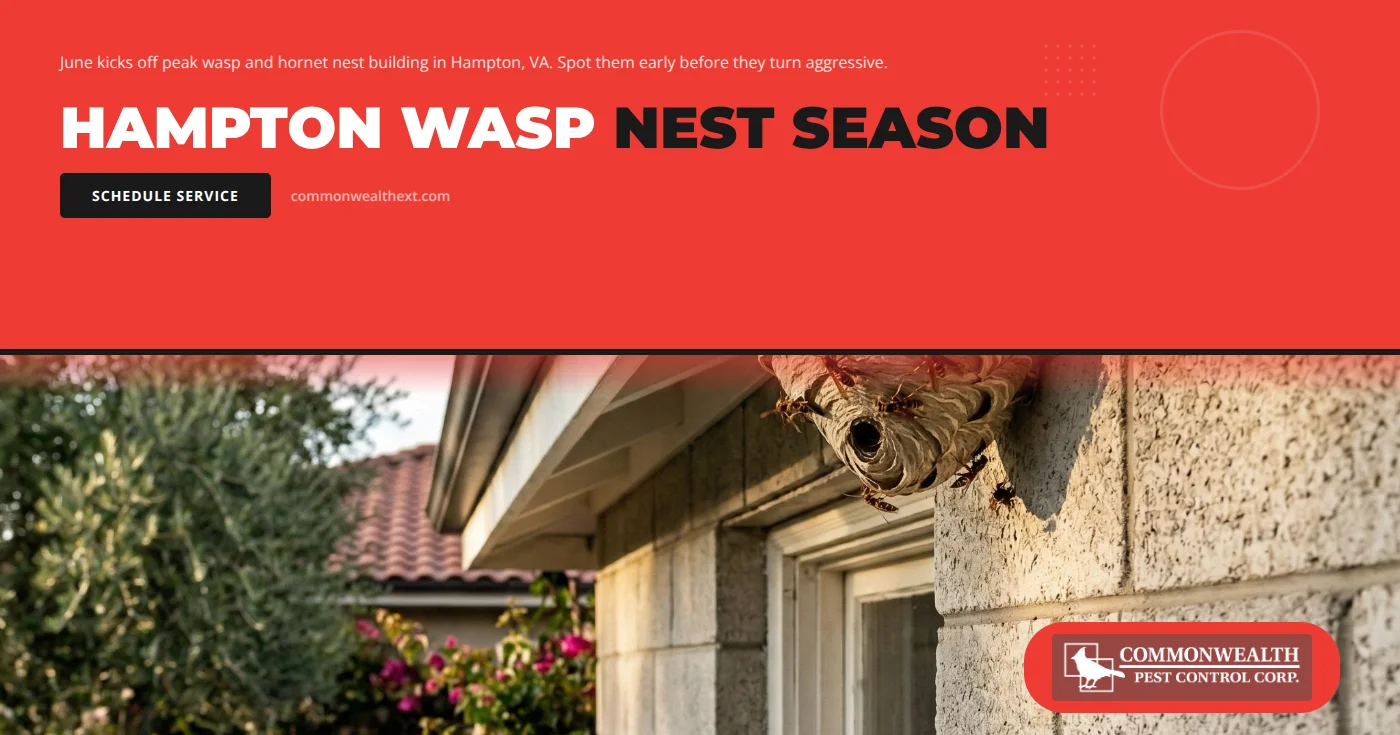
By the first week of June in Hampton, our phones start ringing about the same things: a paper wasp nest tucked under a porch eave, a yellowjacket trickling out of a hole in the lawn, or a gray football-shaped hornet nest hanging off a tree branch. The Virginia Peninsula gets warm, humid, and storm-prone right on cue this time of year — exactly what overwintered queens have been waiting for. As the team that handles wasp control in Hampton VA every summer, we know how fast a small spring nest can grow into a colony you cannot walk past. This guide covers why activity spikes here in June, which stinging insects you are dealing with, where they hide, and what actually works to remove them.
Why Wasp and Hornet Activity Spikes in Hampton, VA Each June
Hampton sits in a humid subtropical pocket of coastal Virginia, and our June weather is the trigger for nearly every wasp and hornet call we run all summer. Daytime highs climb into the low to mid 80s, dew points push past 65 degrees, and humidity stays uncomfortably high most afternoons. That is the exact climate paper wasps, yellowjackets, and hornets need to scale a colony from a handful of workers into hundreds.
The lifecycle explains the timing. Fertilized queens overwinter alone in sheltered spots — under tree bark, in attic insulation, behind shutters — then emerge in April and May to start a nest by themselves. Through May those founding nests are small and easy to miss. By the first week of June, the first generation of workers has matured and taken over construction, freeing the queen to do nothing but lay eggs. According to the University of Maryland Extension, social wasp colonies "last only one season" but expand dramatically through summer before dying off after the first hard freeze (University of Maryland Extension).
That is why nests homeowners barely noticed in May suddenly feel everywhere in June. Hampton's warm spring lets that buildup happen a week or two earlier than it does inland, and coastal moisture keeps paper pulp pliable, so nests grow faster too.
The Most Common Stinging Insects on the Virginia Peninsula
Four species cause the overwhelming majority of stinging-insect calls we treat across Hampton, Newport News, Poquoson, and York County. Telling them apart matters — where they nest and how they defend the colony drives the treatment plan.
Paper wasps are slim, long-legged wasps you see hovering around door frames and porch ceilings — reddish-brown with yellow markings, about three-quarters of an inch long, building open umbrella-shaped nests with hexagonal cells facing down. Colonies stay smaller (20 to 30 workers) but nest where people live: shutters, soffits, mailbox posts, grill covers, and patio furniture.
Yellowjackets are the short, stocky wasps with bright yellow and black bands, about half an inch long. The Virginia Cooperative Extension notes they and the closely related baldfaced aerial yellowjacket are widely distributed across Virginia and become especially defensive when the colony is disturbed (Virginia Cooperative Extension). Most yellowjackets in Hampton build hidden ground nests in old rodent burrows, mulch beds, and wall voids. The entrance is often a dime-sized hole in the lawn — which is why so many stings happen during routine mowing.
Bald-faced hornets are large, black-and-white wasps that build gray, papery, football-shaped nests hanging from tree branches and house eaves. A single nest can grow to the size of a basketball by late summer, and they defend the colony in groups — when one stings, alarm pheromones bring more.
European hornets are the largest stinging insect most Hampton homeowners ever see — over an inch long, brown and yellow, and one of the few wasps that flies and forages at night. They favor hollow trees, barn rafters, and shed walls.
Where Nests Hide Around Hampton-Area Homes and Yards
When our technicians inspect a home for stinging insect control in Hampton, we already know which spots to check first. The hiding places are consistent across older Wythe and Olde Hampton homes, the newer subdivisions out by Hampton Roads Center Parkway, and the waterfront properties along the Back River:
- Soffits, shutters, and porch ceilings. Paper wasps love any horizontal surface with overhead cover — front-porch ceilings, second-story soffits, and the back of vinyl shutters are nearly always the first places we look.
- Wall voids and attic vents. A loose gable vent or a small gap behind siding gives yellowjackets and European hornets a direct path into a wall cavity. We hear the activity in the wall long before workers show outside.
- Ground holes in the lawn and mulch beds. Yellowjackets reuse old rodent burrows. The entrance hole is small enough that a homeowner often mows over it three or four times before getting stung.
- Tree branches and large shrubs. Bald-faced hornets prefer 10 to 30 feet up in a hardwood — magnolias, oaks, and crepe myrtles are favorites. Smaller paper wasp nests show up in dense azaleas and hollies near the foundation.
- Sheds, garages, and outdoor storage. Grill covers, kayak hulls, patio cushion bins, and the underside of a rarely-used trailer are all classic hidden nest spots.
Early Warning Signs a Nest Is About to Turn Aggressive
Stinging insects do not become aggressive overnight. The shift from quietly building to actively defending follows a predictable pattern, and Hampton homeowners can usually spot the warning signs a week or two before the first close call:
- Steady, repeating flight paths. Wasps following the same line in and out of a shutter, vent, or hole in the ground means an established colony at the other end.
- Wasps clustered on the nest surface. A few workers on the outside of a paper wasp nest is normal. A solid mat of workers covering the comb means the colony is mature and on alert.
- Increased numbers around food and drinks. Late-summer yellowjackets shift from hunting insects to scavenging sweets. If wasps are showing up at the pool, on the deck table, or around the trash cans, the colony is large and foraging hard.
- Wasps following you across the yard. Multiple wasps tracking you for 15 to 20 feet means you have crossed into the colony's defended zone and they are escorting you out.
- Audible activity inside a wall, ceiling, or vent. A faint scratching or papery rustling behind drywall almost always means a wall-void nest. By the time the sound is audible from inside, the colony is well established.
If you notice any of these signs, stop yard work in that area and call a professional. Yellowjacket and hornet colonies grow fastest in late June and July, and waiting another week often means dealing with a colony three times the size.
Why DIY Spray Cans Often Make a Hampton Wasp Problem Worse
The most common call we get in early summer is from a homeowner who already tried a can of wasp-and-hornet spray and now has an angrier nest than they started with. The physics of those products do not match what is inside a mature colony.
Aerosol "20-foot jet" cans only treat what they hit. A paper wasp nest under a soffit might have 25 workers on the comb and another 40 to 60 out foraging — the foragers come back agitated whether the nest is intact or not. For yellowjacket ground nests the problem is worse: the colony often extends two to three feet down into the soil, and a surface spray reaches almost none of it. The University of Maryland Extension specifically warns that home remedies like flooding burrows or burning out nests are unreliable and "likely to increase the risk of stings as the agitated wasps escape" (University of Maryland Extension).
Bald-faced hornet nests in trees are the most dangerous DIY target. The outer envelope looks fragile but is actually multiple papery layers thick, and the colony can number several hundred workers by August. A direct spray from a ladder almost always ends with multiple stings — and a still-active colony.
Effective wasp control in Hampton VA uses a different toolkit: residual dust placed directly into the entrance for void and ground nests, knockdown sprays with proper protective equipment for accessible aerial nests, treatments timed for early morning or evening when workers are inside, and removal of the physical nest structure after the colony is neutralized so a new queen does not move in.
How Commonwealth Exterminators Removes Wasp and Hornet Nests for Hampton Homeowners
When you call our team for wasp control in Hampton VA, we start with a full property walk — front, back, sides, soffits, attic accesses, and the lawn. Many of the worst stings happen when a homeowner treats one visible nest and never finds the second in the side yard. We identify the species, locate every active colony, and choose the treatment that fits each nest.
For paper wasp nests under eaves and shutters, we use a targeted knockdown application followed by physical removal of the comb so the spot does not get reused. For yellowjacket ground nests, we apply a residual dust directly into the burrow entrance — workers carry it deep into the colony as they move in and out, reaching the queen and brood in a way surface spray never will. For bald-faced and European hornet nests in trees, attics, and wall voids, we use a combination of dust and aerosol applications timed for low activity, and we return to confirm the colony is fully eliminated before any nest removal.
Read more about the full process on our Stinging Insect Control page, including how we handle species-specific calls for Yellowjacket Control and Hornet Control across Hampton, Newport News, Poquoson, and York County. Our follow-up visits are timed around the colony lifecycle, so we hit the next generation as workers emerge rather than weeks after.
Frequently Asked Questions About Wasps and Hornets in Hampton
When does wasp season start in coastal Virginia?
Queens emerge from overwintering in April and May, and the colonies they start become noticeable in late May and early June across Hampton and the Peninsula. Peak colony size — and peak aggression — arrives in late July and August, with activity continuing through the first hard freeze.
What should I do if I find a hornet nest on my house?
Mark its location from a distance, keep family and pets out of that area, and call a professional. Do not spray it, do not knock it down, and do not block the entrance. Bald-faced and European hornet colonies defend the nest in groups, and a botched DIY attempt is the most common cause of multiple-sting incidents we see in Hampton each summer.
How do I tell a paper wasp nest from a hornet nest?
Paper wasp nests are open and umbrella-shaped with visible hexagonal cells facing down — usually small, gray, and tucked under an eave or shutter. Hornet nests are fully enclosed, gray and football-shaped, with a single entrance hole at the bottom. By August, a hornet nest can be the size of a basketball or larger.
Are wasp treatments gentle around children and pets?
Yes. We use targeted dust and spot-treatment applications rather than broadcast yard sprays, and we design every visit with families and pets in mind. We walk you through re-entry timing before we begin.
How quickly can a wasp colony grow in Hampton's climate?
Fast. A nest that has 10 to 15 workers in early June often has 60 to 100 by the end of July, and bald-faced hornet nests can pass 300 workers by late August. Hampton's humidity shortens the time between worker generations, which is why a small spring nest rarely stays small for long.
If you have spotted a nest, are hearing activity inside a wall, or want to get ahead of the summer surge — reach out to our team. We know Hampton homes, the species we are dealing with each season, and how to clear nests without turning a small problem into a swarming one.