
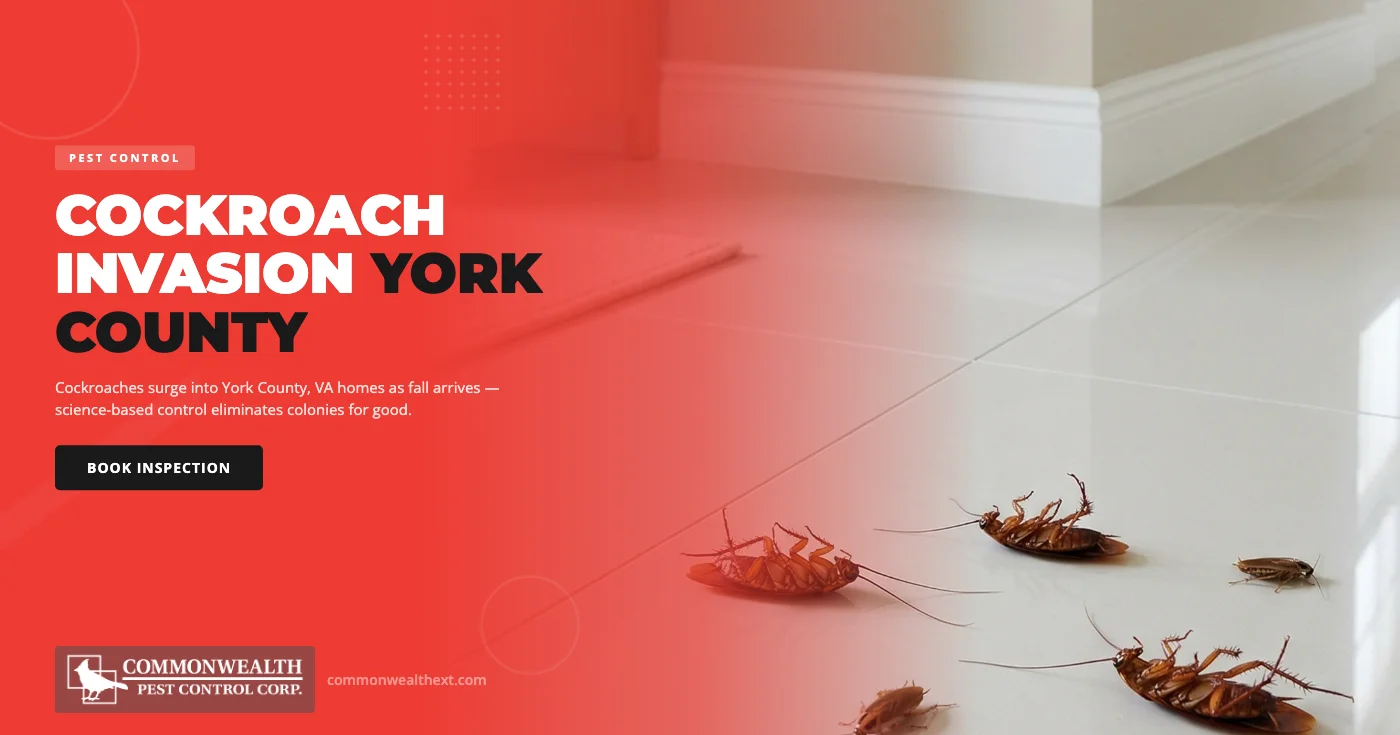
Every September the cockroach phone starts ringing. As overnight temperatures across York County drop into the fifties and daytime highs settle into a comfortable range, cockroach colonies that spent the summer active in wall voids, crawl spaces, and outdoor harborage begin scouting for the warmest, most reliable food and water source in the neighborhood — and homes are almost always the answer. That's why fall is when we field the most roach calls, and why homeowners searching for reliable cockroach control in York County, VA should address the earliest signs of activity before a starter colony becomes a full-scale infestation. Our team at Commonwealth Pest handles cockroach control across York County, Newport News, Hampton, Poquoson, and the surrounding Hampton Roads communities, and we've built our treatment protocol around the science that consistently delivers the highest colony-elimination rates in the industry.
Why Fall Sends More Cockroaches Into York County, VA Homes
Cockroach populations are driven by three environmental variables — temperature, moisture, and food — and fall shifts all three toward indoor colonization across Hampton Roads. Outdoor microclimates that supported American and smokybrown roaches through summer begin cooling. Coastal humidity holds steady but moves indoors as HVAC systems shift to heat cycles that leave bathrooms, kitchens, and laundry rooms consistently warmer and more humid than the surrounding air.
A house radiates a steady 68–75°F through its foundation, plumbing chases, and wall voids, and a foraging cockroach can locate that thermal and moisture signal from a considerable distance. Coastal Virginia's fall weather — warm afternoons, cool nights, plenty of overnight condensation — extends the natural roach activity window into November and December. What starts as a single German cockroach hitchhiking home in a cardboard box from a Newport News grocery run can, in the warm interior of a well-heated York County kitchen, produce three generations before Christmas.
American cockroaches move differently. As sewer temperatures drop and outdoor harborage cools, adults climb up through crawl space vents, garage gaps, and utility penetrations looking for warmer refuge. Older properties in Yorktown and Grafton with brick foundations and sub-floor plumbing chases see the earliest fall roach activity every year, and newer subdivisions in Tabb and Seaford see it too — modern construction leaves plenty of pathways once weatherstripping wears.
The Most Common Cockroach Species Found in Hampton Roads Properties
Effective cockroach control in York County, VA starts with correct species identification. Four cockroach species account for nearly every residential call we handle, and each behaves differently enough that the treatment protocol changes with the species.
German cockroaches are the smallest and most destructive — light brown, about a half-inch long, with two dark parallel stripes behind the head. They are exclusively indoor pests, so a German roach in your kitchen was almost always carried in on packaging, secondhand appliances, groceries, or luggage. A single female can produce up to 400 offspring in her lifetime, and German populations show documented resistance to multiple insecticide classes. The overwhelming majority of established indoor infestations we treat in York County are German cockroaches.
American cockroaches — the reddish-brown, inch-and-a-half "palmetto bugs" most Hampton Roads residents recognize — live primarily outdoors in sewers, storm drains, and moist landscape material. They enter homes through crawl spaces, plumbing traps, and gaps around foundation vents, and their fall migration indoors is what drives most of the "big roach in the bathroom" calls we field between September and November.
Oriental cockroaches — sometimes called "waterbugs" — are dark, glossy, and slow-moving. They favor damp basements, crawl spaces, and mulch beds against the foundation, and their activity picks up sharply in fall when landscape moisture and structural humidity align. Smokybrown cockroaches are outdoor roaches most common in wooded neighborhoods with heavy tree cover — older Grafton and Seaford properties with mature oaks and pines. They rarely establish full indoor colonies but do enter homes seeking overnight warmth as outdoor temperatures drop.
Warning Signs You Have a Cockroach Problem Before It Gets Out of Hand
Cockroaches are secretive by design. They spend the daylight hours packed into wall voids, behind appliances, and in dark harborage where a homeowner will not spot them. By the time a family sees a live roach during daytime hours, the population has almost always been established for weeks — and the visible individuals represent a tiny fraction of the actual colony. The physical evidence, however, is easier to spot once you know what to look for.
- Fecal specks — German cockroach droppings look like ground black pepper or coffee grounds, deposited near harborage: the tops of upper kitchen cabinets, behind the toaster, under the refrigerator, and in the space between the wall and the stove. American cockroach droppings are larger and cylindrical, easy to mistake for mouse droppings but blunt on both ends rather than pointed.
- Egg cases (oothecae) — dark brown, ridged capsules, roughly a quarter to half an inch long. Finding oothecae behind appliances or in cabinet corners means the colony has been reproducing on-site.
- A musty, oily odor — established roach populations produce aggregation pheromones and cuticular hydrocarbons that build up into a distinctive smell. A strange greasy odor from a lower kitchen cabinet or behind the refrigerator is worth taking seriously.
- Live nymphs or adults during daytime hours — cockroaches are nocturnal. Daytime activity typically means harborage capacity has been exceeded and roaches are being displaced from the primary refuges. This is a late-stage warning.
- Shed exoskeletons — piles of pale, papery molts around baseboards, behind appliances, or in cabinet corners indicate active reproduction.
- Smear marks along runways — heavily trafficked roach paths develop dark, greasy smears where the insects rub against surfaces, most commonly under sink cabinets and along the toe-kick under kitchen cabinets.
Why Store-Bought Sprays Fail Against Established Cockroach Colonies
Aerosol sprays and hardware-store bug bombs are the first move for most homeowners who spot a cockroach — and they fail for reasons that go beyond product quality. The failure is structural, and understanding why is the first step toward an effective treatment approach.
Contact sprays kill the roaches they hit. That is the entirety of what they do. A colony of 300 German cockroaches has, at any given moment, three or four percent of its population out foraging where a spray can reach — the rest are packed into wall voids, appliance motor housings, and structural cavities that no aerosol will penetrate. Killing the visible foragers reduces the count by ten or twelve individuals. The remaining 288 keep breeding.
Worse, most retail sprays are formulated with repellent pyrethroids that drive surviving roaches deeper into inaccessible harborage and, in the case of German cockroaches, trigger dispersal responses that spread the infestation to previously uninfested rooms. Fogger bombs push roaches outward from the treatment zone into wall cavities and adjacent structural voids where the homeowner cannot follow.
Egg cases pose the second insurmountable problem. Oothecae are constructed to protect developing embryos from environmental threats, including insecticide exposure. A spray that kills every adult in the home does not affect the 20–40 nymphs inside every intact ootheca, and within two to three weeks those nymphs hatch and rebuild the colony. Finally, German cockroach populations across the United States have developed documented resistance to multiple insecticide classes, and repeated homeowner exposure with the same product accelerates the process.
The APM Approach: Assessment-Based Baiting That Outperforms Standard Treatments
Our cockroach protocol is built on Assessment-Based Pest Management (APM), the framework developed by Dr. Dini Miller — the world's leading authority on cockroach and bed bug control and the researcher whose published work has documented the treatment outcomes that shape modern professional practice. APM is the science we bring to every cockroach control job in York County, VA, and it is the primary reason our colony-elimination rates run substantially higher than the industry standard.
The APM framework rests on three pillars. First, every treatment begins with a thorough infestation assessment — a systematic inspection that quantifies the population, maps harborage, and identifies the specific species. Treatment intensity is calibrated to what the inspection reveals, not to a one-size-fits-all protocol.
Second, the primary treatment tool is high-volume gel bait placement, deployed in dozens of small placements at every documented harborage point. Gel baits work through what entomologists call the "horizontal effect" — a foraging roach consumes bait, returns to the harborage, and its feces, vomit, and eventually its body become secondary bait for the rest of the colony. Baiting at the volume APM specifies gives every roach in the colony access to lethal exposure through this cascade, and Dr. Miller's published research has documented colony elimination rates approaching 98% under APM protocols. That number is not a marketing claim. It is a peer-reviewed outcome that no other treatment methodology in the industry has matched.
Third, APM rotates bait active ingredients across visits to defeat the resistance problem that undermines every static-chemistry approach. Chemical insecticide gets used only when assessment shows it is required — as a supplement to baiting, not the foundation of the treatment. Most competitors do it the other way around: they lead with liquid chemical, empty every kitchen cabinet as a matter of protocol, and hope aggressive disruption drives roaches out. That displaces roaches without eliminating colonies and creates the perpetual retreatment cycle many York County families have experienced with previous providers. APM does not require cabinet emptying because the placement science handles harborage without it.
What a Professional Cockroach Treatment Looks Like in York County
A Commonwealth Pest cockroach service begins with a comprehensive inspection. We walk the entire interior of the home with our clients — kitchen, bathrooms, laundry room, mechanical closets, garage, and any adjacent storage — identify every accessible cockroach harborage location, quantify the population, and produce a written assessment that becomes the roadmap for treatment.
Placement is the core of the visit. Gel bait deployments go behind refrigerators, along the underside of upper cabinets, inside cabinet hinge points, along plumbing penetrations under sinks, at the toe-kick under stoves and dishwashers, inside appliance motor housings when accessible, and at every documented harborage node from the assessment. On a typical German cockroach job we place bait at dozens of locations across a home. Insect growth regulator (IGR) treatments are integrated at the same time to disrupt the reproductive cycle and neutralize the developing oothecae the bait alone cannot reach.
Client instructions are short. Do not clean visible bait deposits for two to three weeks — disturbing them cuts the horizontal effect off before it completes. Do not spray anything over the treated areas. Sanitation adjustments — fixing a slow drain, storing pet food in a sealed container, moving cardboard out of the pantry — get discussed with the family before we leave.
The follow-up visit two to three weeks later is where the outcome is confirmed. Our technician re-inspects the same harborage points, verifies the placements have been consumed, and either steps down to monitoring or supplements placements where the colony has not fully collapsed. That structured follow-up is a required element of APM — the treatments that fail are almost always the ones where a follow-up visit was skipped.
Keeping Your York County Home Cockroach-Free All Year
Long-term cockroach control in York County, VA depends on three things working together after treatment: moisture management, sanitation, and structural exclusion. All three are ordinary homeowner responsibilities, none are complicated, and each one reduces the pressure a Hampton Roads home faces from the roach populations that surround it year-round.
Moisture management is the highest-leverage of the three across York County's coastal humidity. Fix slow drains, address plumbing leaks, run bathroom exhaust fans through the full shower cycle, and keep crawl space vapor barriers intact. Sanitation follows: store pet food in sealed containers, empty kitchen trash on a consistent schedule, and wipe crumbs from behind the toaster and under the refrigerator on a rotating basis. Structural exclusion is the third layer — seal gaps around plumbing and utility penetrations, repair torn crawl space vent screens, and address gaps around windows and exterior doors.
To learn more about our approach, visit our Cockroach Control page or explore additional pest guidance on our Pest Control Blog. Homeowners who want to understand cockroach biology and integrated management principles before calling can start with the University of Kentucky cockroach fact sheet, which covers species identification, biology, and control principles in useful detail.
Commonwealth Pest serves York County, Newport News, Hampton, Poquoson, and the surrounding Hampton Roads communities. Fall cockroach problems compound quickly — every week a colony reproduces is a week of eggs, nymphs, and hidden expansion that the eventual treatment has to work through. If you're seeing early signs of cockroach activity in your York County home, or you want peace of mind before the population establishes, the right next step is scheduling a professional inspection with Commonwealth Pest this week.