
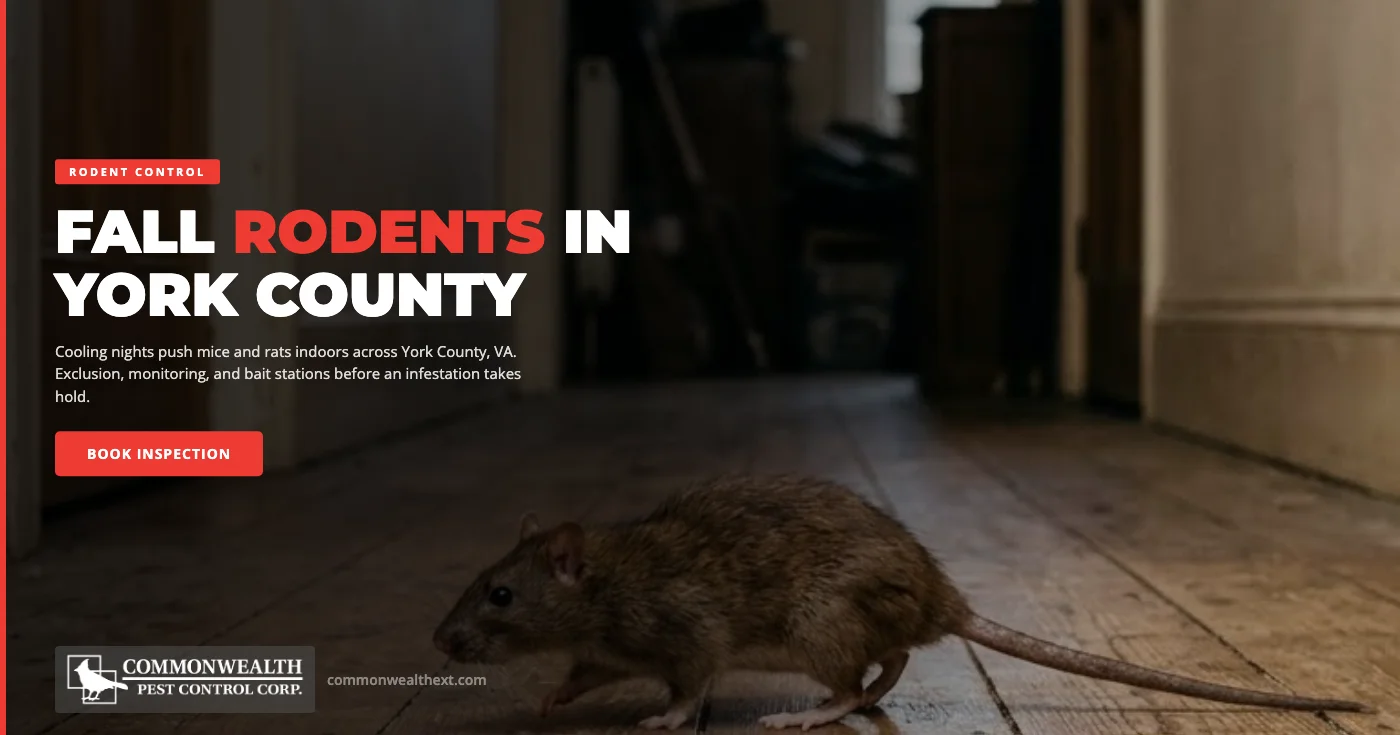
Every September the rodent phone starts ringing. As overnight temperatures in York County drop into the fifties and the first crisp mornings arrive, mice and rats that spent the summer under mulch beds, woodpiles, and fence lines begin scouting for warmer harborage. Homes are the obvious target. Between older waterfront properties near Yorktown, newer subdivisions in Grafton and Tabb, and the mix of wooded lots and open pasture across western York County, the peninsula gives rodents an enormous amount of edge habitat against human structures. That's why fall is when we field the most rodent control calls, and why homeowners looking for reliable rodent control in York County, VA should start paying attention now — before the first mouse in the attic turns into a resident colony. Our team at Commonwealth Pest handles rodent work across York County, Newport News, Hampton, Poquoson, and the surrounding Hampton Roads communities.
Why Fall Is When Mice and Rats Target Hampton Roads Homes
Rodents are driven indoors by a combination of temperature, food availability, and reproductive pressure — and fall lines all three up at once. As nighttime lows drop, the outdoor microclimates that supported mouse and rat populations all summer stop retaining warmth. Mulch beds cool. Woodpiles cool. The undersides of decks and sheds cool. A house, by contrast, radiates a consistent 65–75°F through its foundation, its crawl space, and its attic — a thermal signal a rodent can detect from twenty feet away.
Food availability shifts at the same time. Bird seed, unharvested garden produce, and pet food left on back porches remain attractive, but the natural forage that fed rodents through summer — insects, berries, seeds — starts thinning. That's when a garage with a torn dog food bag, a shed with birdseed on the floor, or a kitchen with poorly sealed pantry staples becomes the most valuable real estate in the neighborhood.
Reproduction adds urgency. A single house mouse can produce five to ten litters a year, each with five or six pups, and juveniles reach breeding maturity in about six weeks. What starts as one pregnant female slipping into a crawl space in early October can become fifteen to twenty active mice by Thanksgiving and a fully established colony by January. The math is why we tell every Hampton Roads homeowner that fall rodent activity has to be addressed the week it's noticed, not the week after the holidays.
How Rodents Get Into York County Properties
Mice and rats do not force their way in. They find existing openings, and York County's housing stock offers plenty of them. A house mouse can squeeze through a gap the width of a pencil — about a quarter inch. A juvenile Norway rat needs only a half-inch gap. Every entry point on a typical home is smaller than most homeowners realize.
The most common entry pathways we identify on rodent inspections in York County fall into a few predictable categories. Utility penetrations — where HVAC lines, plumbing stacks, electrical service, cable, and gas lines pass through the exterior wall — are almost always the first place we find evidence of rodent traffic. The original foam or caulk seal shrinks and cracks within a few years, leaving a quarter-inch gap that a mouse treats as an open door. Garage door corner seals, where the vertical rubber weatherstrip meets the horizontal sweep at the base, are the second common entry: worn seals leave a triangular gap that rats and mice use routinely. Crawl space vents with damaged or missing screens are the third. In older Yorktown homes, deteriorated screen mesh or a foundation vent whose louver has fallen out gives rodents a straight path into the sub-floor.
Attic entry happens higher up. Gable vents, ridge vents, soffit gaps, and the chimney-to-roof-deck junction all give rats access once they climb a downspout, a tree limb, or brick veneer. In wooded neighborhoods across Grafton, Tabb, and Seaford, branches touching the roof are one of the reliable pathways we identify. Trim them back six to eight feet from the roof line and one common access route closes overnight.
Signs of a Rodent Infestation You Shouldn't Ignore
Rodents are nocturnal, secretive, and skilled at staying out of sight. Most families never see a live mouse until the infestation has been established for weeks. The evidence, however, is easy to spot once you know where to look.
- Droppings in enclosed spaces — mouse droppings are dark, rice-grain sized, and pointed at the ends; rat droppings are larger and blunt. Check the back corners of pantry shelves, along baseboards behind furniture, inside kitchen drawers you rarely open, and on top of the water heater and HVAC unit in the garage.
- Gnaw marks on packaging or structural material — chewed corners of cereal boxes, shredded pet food bags, and rounded tooth marks on wire insulation or wooden framing tell you rodents are active and moving between food sources.
- Rub marks along walls — rats and established mouse populations follow the same edges night after night, and the oil from their fur leaves grey-brown smudges along baseboards, under sink cabinets, and at the corners of pantry openings.
- Overnight scratching or scampering in ceilings and walls — activity between dusk and dawn, especially concentrated in the attic or above a specific room, almost always indicates active rodent presence rather than settling of the house.
- Nests of shredded material — insulation, cardboard, fabric, and paper pulled into loose piles in the corners of closets, behind stored boxes in the garage, or inside stored appliances. A nest indicates the population has been in the home long enough to establish and reproduce.
- Pet behavior changes — dogs and cats fixating on a specific wall, cabinet, or ceiling area often detect rodents long before people do. When a pet's attention pattern shifts overnight, take it seriously.
Health and Property Risks of an Untreated Rodent Problem
Beyond the discomfort of sharing a home with rodents, an untreated infestation carries real health and structural consequences that grow with every week the population expands.
Rodents shed pathogens through their droppings, urine, and saliva. Hantavirus, leptospirosis, salmonella, and lymphocytic choriomeningitis virus are the ones public health authorities most commonly associate with mouse and rat exposure in residential settings. Contamination doesn't require direct contact: dried droppings crumble into dust that becomes airborne when disturbed, and pantry surfaces or dishware exposed to overnight rodent traffic can transmit contamination through food preparation. Families with young children, elderly household members, or anyone with a compromised immune system carry the highest exposure risk.
Property damage often outpaces the health impact. Rats and mice gnaw continuously to keep their incisors from overgrowing, and structural wood, insulation, HVAC ductwork, and stored belongings all serve that purpose. Chewed electrical wiring is the risk we treat with the most urgency: rodent damage to wire insulation inside walls and attic spaces is a documented cause of residential fires. Contaminated attic insulation loses its R-value quickly, driving heating costs up. HVAC ductwork breached by rodent traffic distributes airborne contamination throughout the home. None of these reverse on their own, and every week of activity compounds the eventual repair bill.
DIY Traps vs. Professional Rodent Control: Key Differences
Snap traps, glue boards, and hardware-store bait blocks are the default first move for most homeowners who spot rodent evidence — and for a truly isolated single mouse in a garage, a well-placed snap trap sometimes resolves the problem. Across hundreds of York County rodent jobs, however, the difference between DIY and professional rodent control in York County, VA shows up as soon as the population is anything more than a single introduction.
DIY approaches fail in three predictable ways. First, homeowners set traps in the places the mouse was seen rather than the places the mouse is traveling — and rodents follow edges, not open floor. A trap on a countertop where droppings appeared often sits untouched for weeks while mice run the perimeter of the baseboard six feet away. Second, DIY bait placement is almost always exposed rather than protected, which risks pet and child access, produces bait aversion, and drives poisoned rodents to die inside wall cavities where decomposition creates long-term odor issues. Third, DIY treatment addresses the animals present today without closing the entry points that let them in. New rodents replace removed ones within weeks, and the homeowner reads the recurring problem as a treatment failure when the underlying issue is unsealed access.
Professional rodent control approaches the problem as a system. Our inspection identifies every accessible entry point on the structure and produces an exclusion plan alongside the trapping and baiting protocol. We use tamper-resistant bait stations placed along documented rodent runs, protected snap-trap placements in interior harborage locations, and structural exclusion materials — copper mesh, hardware cloth, sheet metal, and appropriate sealants — matched to each entry type. The goal is not to catch this week's mice; it's to end the conditions that made the home rodent-accessible in the first place.
Why Fall Is the Right Time to Call Commonwealth Pest
Every rodent job we handle in December, January, or February started as an unaddressed entry point in September or October. By the time a family hears scratching in the ceiling above the bedroom, or finds droppings in the pantry the week of Thanksgiving, the colony has usually been established for a month or more — and treatment involves more traps, more bait, more visits, and more remediation than the same situation caught at the first sign.
A fall rodent inspection with Commonwealth Pest is the highest-leverage call you can make for winter peace of mind. We walk the exterior of the home, identify every accessible entry point, examine crawl space and attic conditions, and produce a written plan that addresses exclusion, trapping, and monitoring in one integrated protocol. Homeowners across Hampton Roads who address rodent risk in September and October avoid nearly all the winter emergency calls we field from families who waited until they heard something in the walls.
Protecting Your York County Home Year-Round from Rodents
Rodent control is not a one-visit event. The combination of coastal humidity, wooded lots, older housing stock along the York River, and the sheer volume of edge habitat across the peninsula means rodent pressure on York County homes runs year-round, with fall as the annual peak. Long-term protection depends on three things working together.
Exclusion is the foundation. Every quarter-inch gap sealed with copper mesh and appropriate sealant, every damaged crawl space vent screen replaced, every garage door seal repaired, and every tree limb trimmed back from the roof reduces the number of rodents that can access the structure at all. Sanitation and harborage reduction are the second layer — pet food stored in sealed containers, bird feeders positioned away from the house, mulch beds pulled back from the foundation, and clutter reduced in garages, sheds, and outbuildings. Monitoring is the third: tamper-resistant bait stations along the exterior perimeter provide continuous early detection and interception, so the first rodent that arrives at the property never becomes the first rodent in the home.
To learn more about our approach, visit our Rodent Control page or explore additional pest guidance on our Pest Control Blog. Homeowners who want to understand rodent prevention basics before calling can start with the EPA's guidance on preventing rodent infestations, which covers exclusion, sanitation, and integrated pest management principles in useful detail.
Commonwealth Pest serves York County, Newport News, Hampton, Poquoson, and the surrounding Hampton Roads communities. Fall rodent problems only get more involved the longer they're left unaddressed — every week a mouse population continues to grow inside your home is a week the treatment protocol gets longer and more expensive. If you're seeing signs of rodents in your York County home, or you want peace of mind before winter arrives, the right next step is scheduling a professional inspection with Commonwealth Pest this week.