
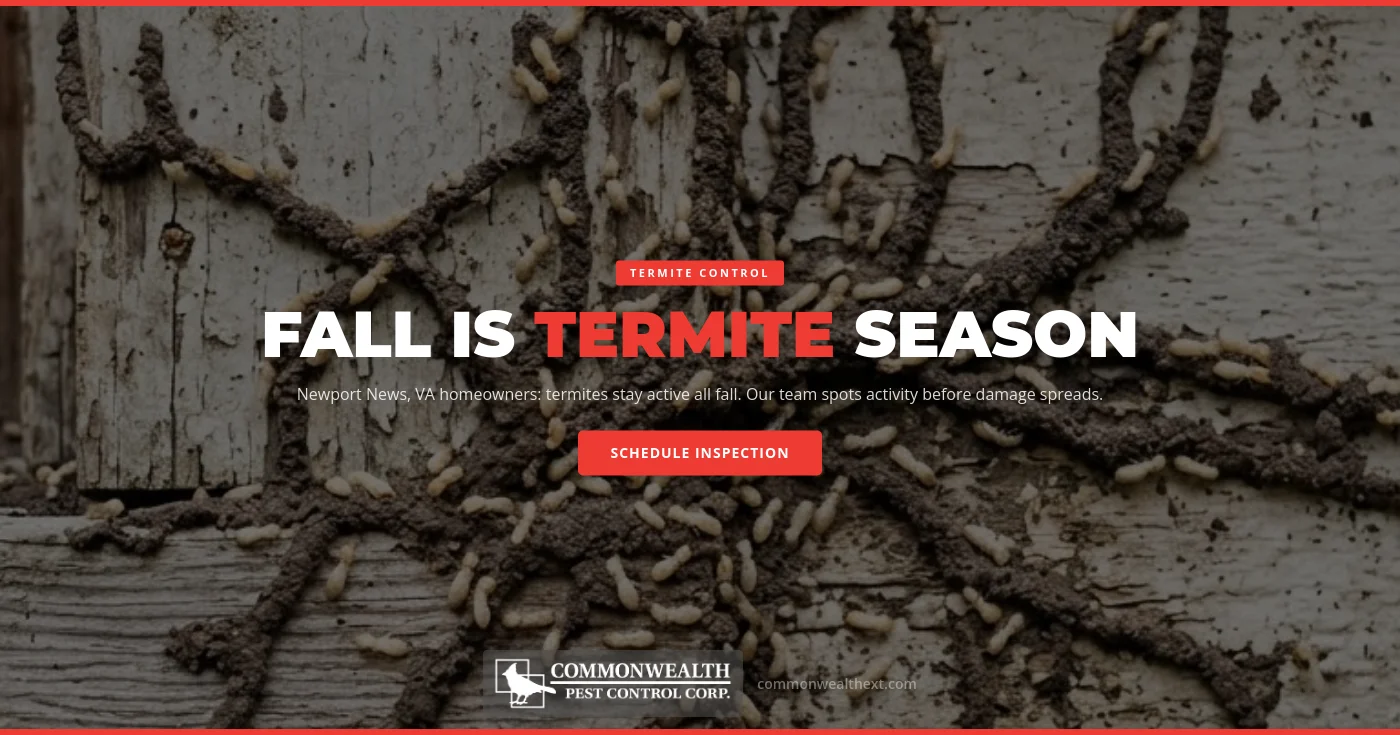
Fall in Newport News looks like relief on paper — the air cools, the mosquitoes thin out, and summer's heavy humidity finally eases off. On the ground, though, one pest doesn't take the hint. Subterranean termite colonies that spent the summer tunneling through soil and feeding on structural wood are still active underneath Newport News homes right now, and they will keep working through most of our mild coastal winter. If you've been assuming that termite pressure drops after Labor Day, we need to walk you through what actually happens on the Virginia Peninsula once the calendar flips to October. Professional termite treatment in Newport News, VA is a year-round conversation here, and fall is one of the most important windows to catch an active colony before another season of damage stacks up.
Why Newport News, VA Homes Remain at Termite Risk After Summer Ends
Newport News sits in a region that pest-pressure analysts consistently rank among the highest in Virginia for subterranean termite activity. That pressure is not a coincidence. It reflects the combination of mild winters, high humidity, sandy coastal soils, and older housing stock with crawl space construction that defines the Peninsula.
Fall doesn't change the geology or the housing stock, and it only partially changes the climate. The soil temperature at the depth where eastern subterranean termite colonies live stays well above the 50°F threshold where foraging slows, right through most of October, November, and early December in Newport News. Combine that with the fact that worker termites can enter a home through a crack as thin as a credit card, and the "fall is quiet season" assumption falls apart quickly.
The homeowners who call us for termite treatment in Newport News, VA this time of year are not reporting new infestations most of the time. They are reporting infestations that have been quietly working for months — sometimes years — and that finally produced visible evidence as cooler air exposed small structural changes, or as a fall cleaning project surfaced mud tubes behind a piece of furniture that hadn't moved all summer.
How Hampton Roads Humidity Keeps Subterranean Termite Colonies Active in Fall
Subterranean termites are moisture-dependent insects. They cannot survive extended exposure to dry air, which is why they build the pencil-thin mud tubes they're famous for — those tubes are climate-controlled travel tunnels that let workers move between the soil and the wood they're feeding on without drying out. Hampton Roads gives these colonies more moisture than they need almost year-round.
A few environmental factors specific to Newport News matter here:
- Coastal humidity. Average relative humidity on the Virginia Peninsula hovers in the 70–80% range even in October and November. That moisture settles into crawl spaces, foundation voids, and the subgrade soil where termite colonies live. Dry air kills workers; our air almost never gets dry enough to matter.
- Sandy, well-drained soil with high water tables. The soils across much of Newport News — particularly in neighborhoods close to the James River, Warwick River, and the lower stretches of Lake Maury — hold just enough water to support colonies without flooding them out. Native eastern subterranean termites thrive in this soil profile.
- Mild late-fall temperatures. First frost in Newport News typically arrives in mid-to-late November, and hard freezes are rare before mid-December. For a colony living two to three feet underground, those surface temperatures matter even less — soil at that depth stays in the 55–65°F range through most of the fall.
- Heated structures. Once your furnace comes on, your home becomes an attractive microclimate for a colony that's already in contact with your foundation. Interior wood near heated spaces stays warm and often slightly moist, which lets worker activity continue through the coldest months of the year.
The practical takeaway: cooler weather does not meaningfully slow a termite colony that is already feeding on your home. It only slows your opportunity to see them before the damage spreads.
Warning Signs of Active Termite Damage Inside Your Newport News Home
Most Newport News homeowners who find out they have termites don't find out because they saw a termite. They find out because they saw something else — something subtle that, in hindsight, had been there for months. Here's what to look for during a fall walk-through of your home.
- Mud tubes along foundation walls, crawl space piers, or basement walls. These are pencil-thin, light brown to dirty gray tubes that run vertically from the soil upward to wood. In Newport News crawl spaces, we most often find them on cinder block piers and along the inside of foundation walls near the sill plate. A single intact tube means an active, foraging colony. A broken-open tube that's been rebuilt means workers are still using the route.
- Wood that sounds hollow when tapped. Subterranean termites eat wood from the inside out, leaving a thin veneer of surface wood intact. Baseboards, door frames, window sills, and crawl space joists that produce a hollow or papery sound when tapped are often the first indicator of structural feeding.
- Blistered or sagging paint and drywall. As workers tunnel through wood behind drywall or trim, moisture from their activity can cause paint to bubble or drywall to buckle in small, isolated patches. These often appear in locations with no obvious water source — that absence of a plumbing explanation is the clue.
- Floors that feel soft or sagging. In Newport News homes with crawl space construction, subterranean termite damage to floor joists and subflooring can produce localized soft spots in bathroom or kitchen floors long before the damage becomes catastrophic.
- Tiny piles of what look like sawdust or coffee grounds. This sign is uncommon with subterranean termites and can point to other wood-boring pests, but it can show up near door and window frames. Any unexplained accumulation of fine wood debris warrants a closer look.
- Discarded wings on windowsills, in bathtubs, or along interior walls. Even outside of spring swarm season, we occasionally see small secondary swarms in the fall from well-established colonies. If you find translucent, equal-length wings — about a quarter-inch long — in or near your home, a colony is almost certainly already present inside the structure.
If you spot any of these signs, the next move is a professional inspection — not a trip to the hardware store. Over-the-counter sprays do not reach the colony and often push termite workers deeper into harborage areas, making the eventual professional treatment harder to design.
The Difference Between Termite Swarms and Worker Colony Activity This Time of Year
Most people associate termites with spring swarms — the brief, dramatic appearance of winged reproductives on a warm, humid day in March or April. That image is accurate for one specific moment in the colony's annual cycle. It also obscures what's actually happening the other 11 months of the year.
A mature subterranean termite colony in Newport News is made up of three functional castes: the workers, the soldiers, and the reproductives. The reproductives include the king, the queen, and the alates — the winged termites that emerge in spring (and occasionally in fall) to establish new colonies elsewhere. The workers, which make up the vast majority of the colony, are blind, soft-bodied insects that spend their entire lives tunneling through soil and wood in search of cellulose. The soldiers defend the tunnels.
Here's the key point for fall: workers do not stop working just because the alates aren't flying. In most Newport News infestations, the structural damage is being done by workers 365 days a year, with brief, visible swarms happening only once annually. The absence of a swarm this fall does not mean your home is clear. If anything, the quiet months are when active colonies cause the most undetected damage, because homeowners aren't actively watching for pests.
Occasionally, in Hampton Roads homes with large, mature colonies — especially those with ongoing moisture problems or structural wood contact with soil — we do see a secondary fall emergence of alates after a warm rain in October or early November. If you spot winged termites or shed wings inside your Newport News home at any time of year, treat it as a confirmed infestation and schedule an inspection immediately.
What a Termite Inspection Reveals in a Newport News Property
A thorough termite inspection in a Newport News home is not a quick walk-around. When our team arrives, we methodically evaluate the structure from the ground up — because subterranean termites almost always enter from the soil, and the evidence of entry is often most visible in places homeowners never look.
In a typical Newport News inspection, we spend significant time in the crawl space. We examine every pier, every section of sill plate, and every floor joist for mud tubes, surface damage, and moisture staining. We check the vapor barrier for gaps and the vents for proper airflow — poor crawl space ventilation is one of the top contributors to termite pressure on the Peninsula. We note moisture readings on structural wood and flag any wood-to-soil contact, including deck posts, porch supports, and buried utility penetrations.
Inside the home, we inspect baseboards, door and window frames, and any wall surface where damage might be hiding. We look at bathroom and kitchen floors for soft spots, around plumbing penetrations for mud tube activity, and inside closets and crawl space access panels for discarded wings or frass. We also walk the exterior perimeter, checking for conducive conditions — mulch piled against siding, wood debris near the foundation, grading that funnels water toward the house, and any landscape timbers or decorative wood in direct ground contact.
When we're done, we document what we found and what we didn't. If there's no active termite activity, we tell you that directly and recommend an appropriate monitoring interval. If there is active termite activity, we show you exactly where, explain what species we're seeing, and build a treatment plan around the specific pressure points in your home. Our Termite and Moisture Inspection service is designed to give homeowners the complete picture, not a sales pitch.
How Commonwealth Pest Treats Active Colonies in Newport News, VA
Our approach to termite treatment in Newport News, VA is built on the principle that treatment design should match what the inspection actually revealed — not a generic protocol applied to every home. The specific combination of foundation type, crawl space conditions, soil profile, and infestation extent dictates which treatment tools we deploy and in what sequence.
For most Newport News homes with confirmed subterranean termite activity, we use one of two primary treatment strategies, often in combination:
Liquid soil treatment with a non-repellent termiticide. This creates a continuous treated zone in the soil around and beneath the structure. Non-repellent products are not detected by foraging workers, so termites pass through the treated zone, carry the active ingredient back to the colony, and transfer it to other colony members through contact and grooming. This cascade effect is what drives colony-level elimination rather than just killing workers at the perimeter.
In-ground bait station monitoring and elimination systems. We install stations around the perimeter of the home at regular intervals. When workers locate a station, we switch the station to a cellulose matrix laced with an insect growth regulator. Workers consume the matrix and share it with the colony, where it disrupts the molting cycle of other termites and collapses the colony over subsequent weeks. Bait stations are classified under the EPA's reduced-risk pesticide program and are an excellent fit for Newport News homes with children, pets, well water concerns, or sensitive landscaping.
For homes with contributing moisture problems — and in Newport News, that's a substantial share of the properties we inspect — we also address the underlying conditions. That might mean recommending vapor barrier repair, crawl space encapsulation, drainage corrections, or gutter and downspout adjustments. Treating termites without addressing moisture is a short-term win; addressing both is how we help homeowners stay out of the termite cycle long-term.
Our full approach is detailed on our Termite Treatment service page, and we're happy to walk you through what a treatment plan would look like for your specific property.
Protecting Your Newport News Home From Termite Damage Year-Round
Treatment eliminates an active colony. Prevention keeps the next one from establishing. For Newport News homeowners, year-round termite risk reduction comes down to a handful of structural and environmental habits:
- Keep wood off the soil. No landscape timbers, deck posts, or structural wood in direct ground contact without a proper barrier. This is the single most common conducive condition we flag during Peninsula inspections.
- Maintain crawl space moisture control. A properly installed vapor barrier covering 100% of the crawl space floor, functional foundation vents (or a properly designed encapsulation system), and routine checks for standing water make a measurable difference in termite pressure.
- Address drainage at the foundation. Downspouts should discharge at least six feet from the foundation. Grade around the house should slope away. Standing water near the perimeter is an invitation to subterranean colonies.
- Reduce mulch depth near the foundation. We recommend no more than two inches of mulch within 18 inches of the siding, and ideally a mulch-free strip immediately adjacent to the foundation.
- Store firewood away from the house. Minimum 20 feet from the structure, ideally elevated off the ground. A woodpile against the siding is the fastest way to invite a colony onto the home.
- Schedule annual termite inspections. Even if last year's inspection was clean, soil conditions, moisture dynamics, and nearby colony activity change year over year in Newport News. An annual professional inspection is the single highest-leverage prevention step for Hampton Roads homeowners.
Fall is a strong window for all of this. Landscape work is easier in cooler weather, crawl spaces are more accessible before pipes start to freeze, and scheduling an inspection now puts you ahead of the spring rush when swarm season brings our calendar to its busiest point of the year.
If you're seeing anything that concerns you — mud tubes, hollow-sounding wood, wings on a windowsill, floors that feel softer than they used to — we can help. Our team covers Newport News, Hampton, Poquoson, and York County, and we bring the same methodical, inspection-first approach to every property we treat. Newport News homes are worth protecting, and the earlier we identify an active colony, the simpler and more targeted the treatment can be.