
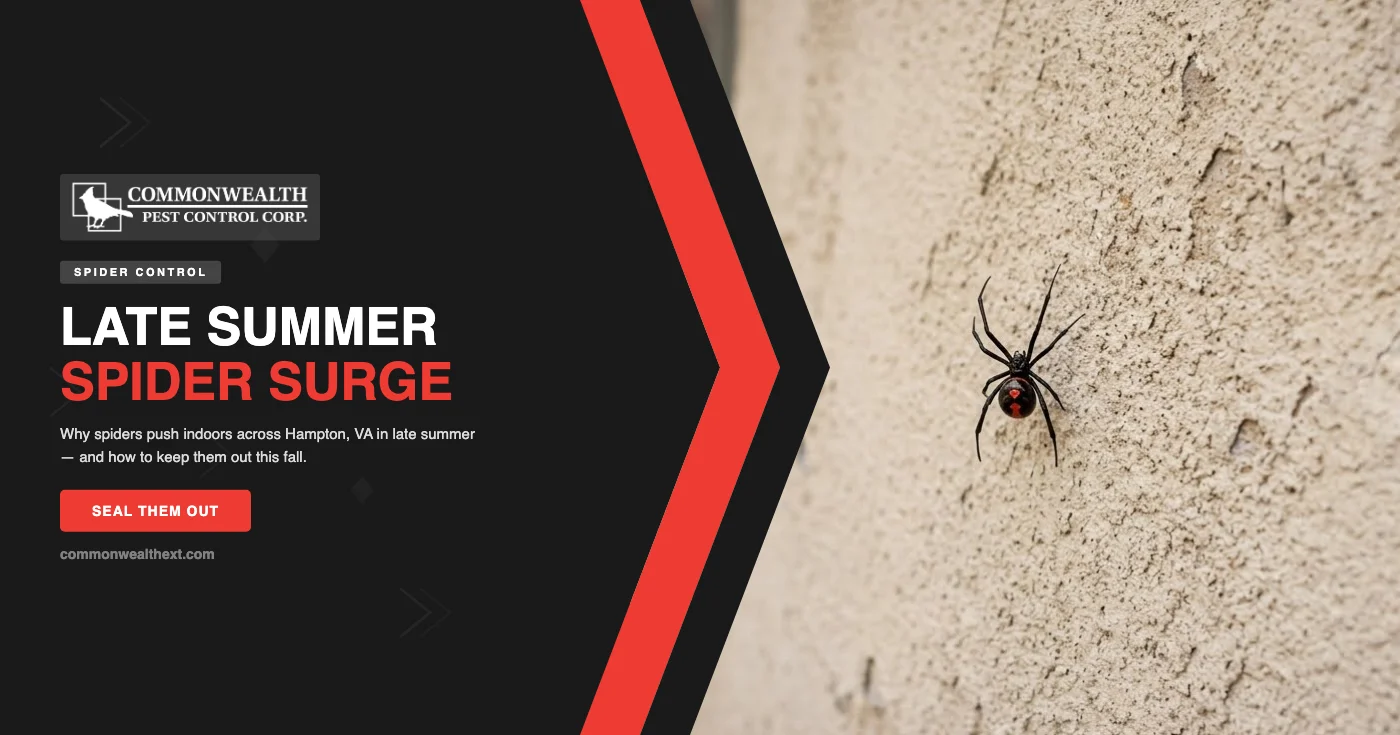
Hampton in late summer has a rhythm all its own — sticky afternoons on the water, marine air that keeps humidity locked in long after sunset. That same coastal humidity, combined with a specific stretch of the calendar, is what turns August and September into the busiest spider season of the year for Hampton, VA homes. Every year around this time, we start getting calls from Hampton residents who spot a wolf spider streaking across the living room floor or find a cellar spider tucked into a bathroom corner. Here's what's happening biologically, and what expert spider control in Hampton, VA looks like when it's done right.
Why Spiders Surge Indoors in Hampton During Late Summer
If you're watching your baseboards more carefully in August than you were in June, there's a reason. Hampton sits at the mouth of the Chesapeake Bay in a landscape shaped by tidal water, sandy soils, and a persistently high water table. That combination supports enormous insect populations — and where insects thrive, spiders follow.
Spiders themselves are seasonal. Most species reach full maturity in late summer, so the eight-legged residents of your Hampton yard have spent months growing and refining their hunting territories. By August, they're at peak size and reproductive readiness — some visible, many others present all along and only now large enough to catch your eye.
What triggers the surge indoors isn't just size. Three things happen almost simultaneously in Hampton Roads during late summer: outdoor insect populations peak, humidity stays high while nights start to cool, and male spiders become active in ways they weren't earlier in the year. That combination pushes spiders across the threshold between "outdoor pest" and "indoor sighting" — and it's why we see call volume for spider control in Hampton, VA nearly double between mid-August and mid-October.
It's Mating Season: What Drives Spiders Inside Now
The single biggest driver of late-summer spider sightings in Hampton is mating behavior. The spiders you're finding indoors right now are almost always males on the move, actively hunting for females.
Here's how it works. Females stay stationary on their webs, releasing pheromones. Once temperatures and daylight patterns trigger the mating window — typically mid-August through early October in coastal Virginia — sexually mature males abandon their home territories and wander long distances in search of those chemical signals.
That wandering behavior is what carries them across your driveway, up your foundation, through a gap in a door sweep, and onto your kitchen floor. The wolf spider you saw sprinting across the carpet at 10 p.m.? Almost certainly a male in search of a mate. The house spider tucked into an upper corner of the garage? Same pattern.
Because males don't occupy persistent webs, the classic sign of mating-season activity in a Hampton home isn't a sudden explosion of webs but an increase in loose sightings — one spider here, another there, moving through spaces where you don't normally see them. Mating season has a natural end, too. Male populations drop off substantially by November, which is why late-fall sightings taper even before the first hard cold.
Common Spiders You'll See in Hampton Roads Homes
Not every spider you encounter in Hampton is the same, and correct identification matters. These are the species we most often find during the late-summer surge in Hampton homes.
Common House Spider (Parasteatoda tepidariorum)
Small, tan to grayish, and often mistaken for other species, the common house spider has adapted so thoroughly to human structures that it's rarely found outdoors anymore. Females build tangled webs in corners of garages, basements, attics, and behind furniture. During mating season, wandering males become a common late-summer sighting throughout Hampton homes.
Wolf Spider (Family Lycosidae)
Wolf spiders are large, fast, brown-to-gray hunting spiders with a distinctive eye arrangement — four small eyes on the bottom row and four larger eyes above. Unlike web-builders, they're active predators that chase down prey. In Hampton, they're often spotted in garages, basements, and ground-floor rooms during late summer as males roam. They look intimidating but are not aggressive toward people.
Cellar Spider (Pholcus phalangioides)
Often called "daddy longlegs," cellar spiders have small pale bodies and long, thin legs. They build loose, disorganized webs in basements, crawl spaces, and low-traffic corners. They're beneficial in the sense that they prey on other spiders — including species homeowners find more alarming — but their webs accumulate quickly and are unsightly.
Orb Weaver (Family Araneidae)
Orb weavers build the classic symmetrical wheel-shaped webs across porches, decks, garden gates, and window frames during late summer. Many species are colorful and dramatic-looking. They're primarily outdoor spiders, but their webs on Hampton front porches and around exterior lighting become impossible to ignore in August and September.
Yellow Sac Spider (Cheiracanthium spp.)
Small, pale yellow to greenish, and quick-moving, yellow sac spiders build small silk retreats in ceiling corners and behind picture frames. Their bites can cause mild reactions in some people, though serious effects are rare. They are more likely than most Hampton house spiders to bite defensively if pressed against skin — often at night, when they've slipped into bedding.
How Coastal Humidity and Prey Insects Bring Spiders In
Coastal Virginia is spider country for a specific ecological reason: spiders depend entirely on other insects for food, and the environment around Hampton supports insect populations that inland areas simply don't match.
Hampton's high water table, wetlands, marshes, and long humid summer keep insect activity elevated for months at a stretch. Mosquitoes, gnats, midges, flies, and moths reach massive populations near coastal water — and those insects are the base of the spider food web. Where you have abundant flying prey, you inevitably have web-builders positioned to catch them.
That's why Hampton homes near the water — Buckroe Beach neighborhoods, Fox Hill, and homes bordering tidal creeks — see especially heavy orb weaver activity across porches, garages, and outdoor lighting during late summer. Exterior lights attract insects; the insects attract spiders; the spiders build webs that make the connection visible overnight.
Humidity plays a direct role, too. Cellar spiders, house spiders, and wolf spiders all need moderate to high humidity in their habitat. The humid air inside Hampton homes during August is well within their preferred range, particularly in crawl spaces, garages, and around the exterior perimeter. When outdoor conditions become slightly less hospitable at night, those moisture-rich indoor spaces become the more attractive option.
Which Spiders Around Hampton Deserve Extra Caution
Most spiders in Hampton are more nuisance than threat. Their bites are rare, and even when they happen, most produce reactions no worse than a mosquito bite. Two species, though, do warrant caution.
Black Widow (Latrodectus mactans)
The southern black widow is native to Virginia and does occur in Hampton, though it's uncommon inside living spaces. Females are unmistakable — glossy black, roughly half an inch long, with a bright red or orange hourglass marking on the underside of the abdomen. They prefer undisturbed spaces: woodpiles, outdoor sheds, garages, corners of crawl spaces, and gaps in outdoor furniture. Black widow venom is medically significant, and bites should be evaluated by a medical professional. If you find a black widow on your Hampton property, don't attempt to handle it — that's a call to us.
Brown Recluse (Loxosceles reclusa)
The brown recluse has a reputation that outpaces its actual presence in Hampton. The species is primarily found in the south-central United States, and its confirmed range in Virginia only reaches the far southwestern corner of the state. Verified brown recluse encounters in Hampton Roads are rare. Many spiders reported as brown recluses in this region are actually wolf spiders, sac spiders, or other harmless brown species. If you believe you've seen one — with the distinctive violin-shaped marking on the cephalothorax — save the specimen if possible for identification.
For every other spider you're likely to see in your Hampton home, the appropriate response is careful removal and prevention, not alarm. According to the National Pesticide Information Center, most spiders are beneficial predators that help suppress other insect populations — the goal of professional spider control isn't extermination of every spider on the property but management of populations to keep them out of living spaces.
Prevention Tips to Seal Spiders Out This Fall
The best time to reduce late-summer spider sightings in a Hampton home is before the mating-season surge peaks. If you're reading this in August or early September, there's still time to make meaningful changes.
- Seal exterior entry points. Foundation cracks, gaps around utility penetrations, damaged door sweeps, and torn window screens are the routes wandering males use to enter Hampton homes. Walk your foundation perimeter and address anything larger than a pencil-tip gap.
- Manage exterior lighting. Bright white porch and garage lights attract the flying insects that spiders feed on. Switch to warm-color LEDs or yellow-tinted bulbs, and keep exterior lights off when they're not needed.
- Clear vegetation and debris away from the foundation. Overgrown shrubs, leaf piles, ivy on siding, and firewood stacked against the house all give spiders sheltered harborage. Aim for at least 12 inches of clearance between mulch beds and siding.
- Vacuum indoor webs rather than spraying them. A vacuum removes spiders, webs, and egg cases more thoroughly than spot sprays — and takes down the physical structure that draws more insects.
- Address moisture in crawl spaces and garages. Damp enclosed spaces are exactly where cellar spiders and wolf spiders establish. A working vapor barrier, a dehumidifier, and repaired plumbing leaks all reduce the conditions spiders prefer.
- Reduce the indoor insect population. Spiders indoors need insects indoors to survive. If you're seeing a lot of spiders in one area, there is almost always an insect population supporting them.
- Keep clutter down in storage areas. Boxes stacked in garages, attics, and basements create dozens of small dark spaces spiders use as harborage. Sealed plastic bins are better than cardboard.
These changes are practical and largely free. In combination with a well-designed exterior pest control program, they're what separates a Hampton home that sees the occasional spider from one that sees a steady stream of them from August through October.
When to Call Commonwealth Exterminators for Spider Control
DIY spider control has limits — especially during mating season, when the pressure from wandering males is high and continuous. If you've sealed what you can seal, reduced clutter, addressed exterior lighting, and you're still finding new spiders indoors on a regular basis, that's the point at which professional intervention makes sense.
Our approach to spider control in Hampton, VA is grounded in the same philosophy that shapes every service we deliver: inspection first, treatment based on what the inspection actually reveals, and ongoing pressure management rather than one-and-done spraying. Spider issues are almost always downstream of two other factors — insect prey availability and structural conditions around the home. Address those, and the spider problem largely resolves.
When you contact us for a Hampton spider issue, our technicians walk the exterior of your home, identify the species present, locate the harborage areas driving indoor sightings, and evaluate the environmental conditions creating pressure. From there, we build a treatment plan tailored to your property — focused on perimeter and eave treatment where it will make the most difference, with gentle, family-conscious application indoors only where warranted.
We serve Hampton, Newport News, Poquoson, York County, and the surrounding Hampton Roads communities. To learn more about what we do, visit Commonwealth Exterminators, or explore the rest of our blog for pest-specific guidance for coastal Virginia homes. Late summer here doesn't have to mean spiders on your ceiling and webs on your porch every morning — with the right approach, spider issues become manageable, and we're ready to help you get ahead of the surge this season.