
Late August in Poquoson has a particular stillness — hot afternoons, heavy coastal air, and evenings that never really cool off. Under all of that, subterranean termite colonies are still very much at work in Poquoson crawl spaces and slab edges. Most homeowners assume termite season ends when the spring swarms stop, but that isn't how these insects operate — and in a coastal Virginia climate, late summer is when quiet, ongoing termite damage does some of its heaviest work. This guide walks through what's happening biologically, what the damage looks like, and what expert termite control in Poquoson, VA involves when it's done right.
Why Termite Colonies Stay Active in Poquoson All Summer Long
Spring is when termites make themselves visible. The winged reproductives (called alates) pour out of the ground on warm humid afternoons in March and April, mate, and disappear. That highly-visible swarm event is what most homeowners associate with "termite season." Swarming, though, is only the reproductive phase of a colony that never actually stops.
In Poquoson, the eastern subterranean termite (Reticulitermes flavipes) — the dominant species across Hampton Roads — is a year-round pest. Once swarms have finished by early May, the workers and soldiers that make up the vast majority of any colony continue foraging, tunneling, and feeding without pause. Colonies of hundreds of thousands of individuals feed 24 hours a day, seven days a week. Nothing about summer slows them down.
If anything, the opposite happens. Colonies adjust their foraging depth based on soil temperature and moisture, and in a Poquoson August, both conditions are ideal. Warm shallow soils speed metabolism and growth. High humidity keeps their soft bodies from drying out. Every biological input a termite colony needs is at peak in the middle of summer.
That's why the answer to "why are termites still active in August in Virginia" is straightforward: they never left. Poquoson homeowners who assume no visible swarm means no termite pressure are missing what's happening under and around their homes right now.
How Coastal Humidity Makes Poquoson Homes Prime Termite Targets
Poquoson sits at the eastern edge of a peninsula surrounded by water — the Poquoson River, the Back River, and the Chesapeake Bay define the town's geography. That coastal setting produces a specific kind of pressure on the local wood.
Subterranean termites are extremely susceptible to desiccation. Their soft bodies lose water rapidly in dry air, so they must stay in contact with moisture at all times. In inland regions with drier soils, that requirement is a serious constraint on where colonies can establish and how far they can forage. In coastal Poquoson, it isn't a constraint at all.
Poquoson's high water table keeps subsurface soils moist year-round. Marine humidity keeps ambient moisture elevated through most of the summer. Frequent afternoon storms recharge shallow soil water on a regular cycle. Together, those conditions eliminate the natural moisture bottleneck that would otherwise limit termite activity — colonies can forage close to the surface, extend mud tubes farther, and exploit food sources that would be inaccessible in a drier region.
The Hampton Roads corridor, including Poquoson, is classified as Zone 3 (moderate-to-heavy activity) on the national Termite Infestation Probability map. That classification isn't abstract. It reflects the specific combination of climate, soil moisture, and construction style that makes coastal Virginia homes some of the most termite-vulnerable in the state.
What Late-Season Termite Damage Looks Like in Your Walls and Floors
The damage most Poquoson homeowners eventually notice is the result of months or years of feeding — and it's often subtle until it isn't. Because subterranean termites feed inside wood rather than on the surface, their presence is usually revealed by structural symptoms rather than obvious external chewing.
Watch for:
- Floors that feel spongy or that flex under weight, particularly near exterior walls, bathrooms, and kitchens where sill plates and joists meet crawl-space moisture.
- Baseboards that pull away from the wall or paint that bubbles and cracks along horizontal seams — moisture-driven blistering from termite galleries just beneath the surface.
- Wood trim that sounds hollow when tapped, a classic indicator that the interior has been galleried out while the paint film stays intact.
- Windows and doors that stick or fit tightly in their frames even after the humidity drops.
- Small pinholes in drywall or wood surfaces, sometimes with a faint smear of dried soil nearby.
The specific pattern of subterranean termite damage — hollowed-out galleries running with the grain, following the softer spring wood while leaving the harder late wood as a thin shell — is diagnostic. When we open up damaged material, we typically find a honeycombed interior that a homeowner walking past couldn't have seen. That's why termite damage signs in Poquoson so often come to light during renovations, floor replacements, or moisture inspections rather than through casual observation.
Subterranean Termites in Hampton Roads: How They Tunnel and Feed
Understanding how subterranean termites in Hampton Roads behave underground makes their damage patterns above ground make sense. These aren't drywood termites that establish colonies inside a wall. They live in the soil, and they commute to your house.
A typical eastern subterranean termite colony spans a network of underground galleries that can extend 100 feet or more from the central nest. Workers follow chemical and moisture gradients through the soil, exploring in every direction until they encounter cellulose — a tree stump, a root, buried construction debris, or the wood framing of your Poquoson home. Once a food source is located, workers construct mud tubes to bridge the gap between soil and food while keeping the vulnerable interior of the tube humid and protected.
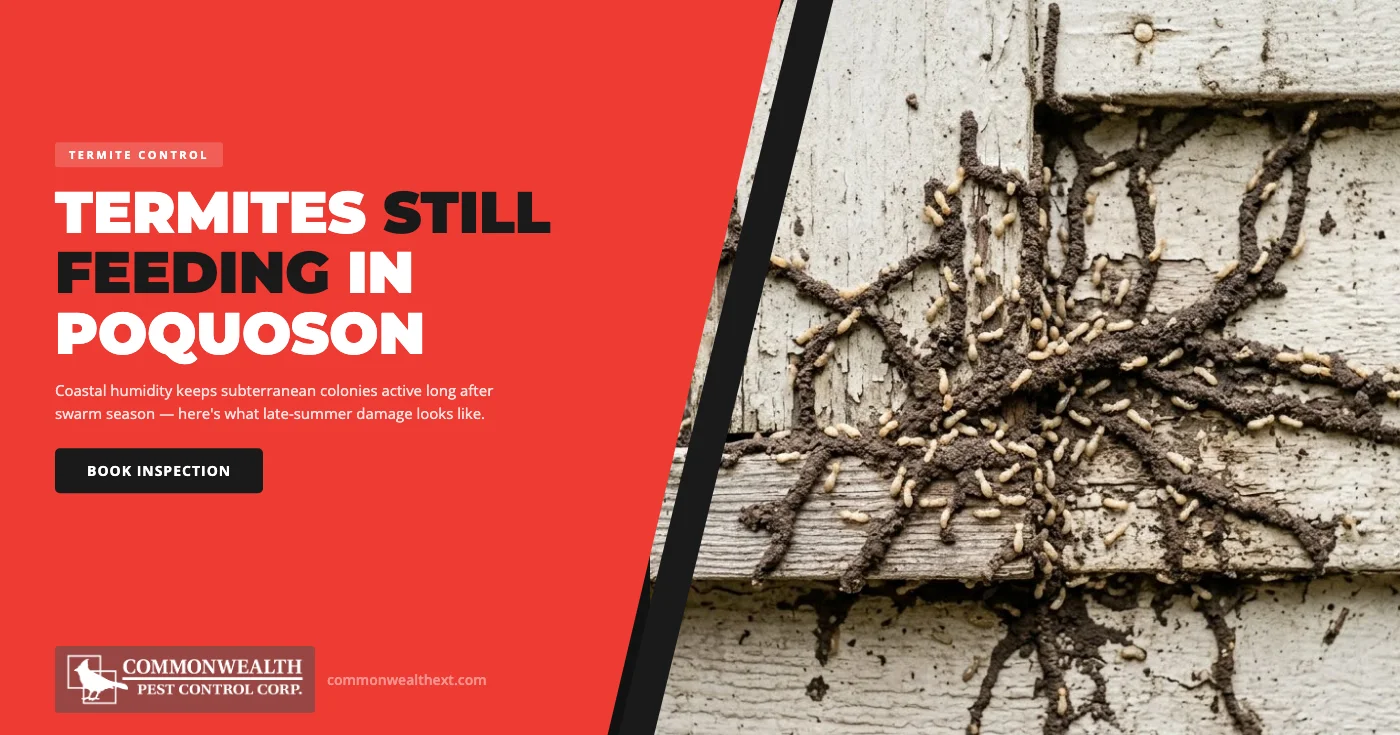
Those mud tubes are the single most reliable sign of an active infestation. Pencil-width columns of packed soil and saliva running up a foundation, along a crawl-space pier, or across a slab edge is an active supply line carrying workers from soil to wood every day.
Because Poquoson homes so frequently sit on crawl-space foundations rather than full basements, the termite pressure often concentrates in the crawl space itself. Sill plates, subfloor joists, band boards, and any framing that comes near the soil are the natural first targets. Homes with structural wood that contacts soil directly — porch posts, deck ledgers set too low, buried siding — provide the fastest possible route from colony to food.
Warning Signs Every Poquoson Homeowner Should Check Before Fall
Before the weather cools, take an hour to walk your Poquoson property and look for the indicators that suggest termite activity is already underway. Here's the checklist we walk when a homeowner books a Poquoson VA termite inspection or calls us about termite control in Poquoson, VA:
- Foundation perimeter. Look for mud tubes on the exterior of the foundation and inside crawl-space openings. A single pencil-width column of dried mud is worth investigating.
- Crawl space. Get eyes on the sill plates, band boards, and floor joists. Look for mud tubes running along wooden surfaces, discoloration, or wood that appears to have been "sanded" by galleries beneath.
- Interior baseboards and trim. Any bubbling paint, warped baseboard, or hollow-sounding trim near an exterior wall deserves a closer look.
- Wood-to-soil contact points. Deck posts, porch columns, fence attachments, and stair stringers touching soil are the highest-priority items on any Poquoson property.
- Around plumbing penetrations. Termites exploit small gaps around pipes entering the crawl space or slab. Look for evidence of soil around those penetrations that shouldn't be there.
- Swarmer wings. Even though the spring swarm is over, small piles of shed wings near windows or exterior doors indicate a mature, established colony that recently produced reproductives.
If you find any of these signs — or if the question "how do I know if my Poquoson home has termites in summer" has been on your mind for a while — the answer is almost always to book a professional inspection rather than trying to interpret the evidence yourself.
Why End-of-Summer Is the Right Time to Schedule a Termite Inspection
Most Poquoson homeowners think of termite inspections as a spring task, tied to swarm season. That reflex is understandable — swarms are visible. From a purely diagnostic standpoint, though, late summer is actually one of the better windows for a thorough termite control in Poquoson, VA inspection.
Here's why. After several months of continuous warm-weather feeding, any active infestation has had time to develop visible signs. Mud tubes are established, damage patterns are advanced enough to detect with a probe, and swarmer wings from the spring may still be present. A colony that would have been ambiguous in March is often clearly identifiable by August. The evidence pool is deeper.
Late summer is also the right time to address any moisture problems that would have made your home more attractive to termites through fall and winter. Crawl-space vapor barriers, drainage corrections, gutter improvements, and grading fixes take time to install and dry out. A moisture-driven termite risk identified in August can be corrected before the wet season starts and the pressure worsens.
Scheduling a termite inspection now — rather than waiting for spring — gets you into the treatment queue before the seasonal rush. Every year we see Poquoson homeowners who discovered damage in March scramble for a slot behind hundreds of others. Booking now is simpler.
How Commonwealth Exterminators Treats Termite Colonies in Poquoson
Our approach to termite treatment coastal Virginia homes need is grounded in the philosophy that shapes every service we deliver: inspect first, base treatment on what the inspection actually reveals, and choose the method that fits the structure and the colony pressure rather than defaulting to one-size-fits-all.
Every termite job we take in Poquoson starts with a full inspection of the crawl space, foundation, structural wood, and moisture conditions. Our technicians document what they find, identify the species (eastern subterranean in nearly every case, with careful attention paid to the possibility of Formosan subterraneans in coastal neighborhoods), and map out the extent of the colony pressure before recommending anything.
From there, treatment typically involves one or a combination of the following:
- Liquid soil termiticide applied along the foundation perimeter to create a continuous treatment zone that intercepts foraging workers as they move between the colony and the structure. This remains the workhorse of subterranean termite work in Poquoson because it addresses the entire foraging population, not just the wood the workers have already reached.
- In-ground bait stations installed around the perimeter of the home. Workers recruit nestmates to the stations, and the active ingredient is carried back to the colony through normal food-sharing behavior, targeting the queen and the reproductive core over time.
- Localized wood treatment for any structural members with active galleries, including borate applications where appropriate.
- Moisture control recommendations — because subterranean termites and moisture are inseparable, addressing water intrusion in the crawl space, drainage away from the foundation, and vapor barrier condition is part of any long-term termite management plan.
Termite work is not the place for shortcuts or one-and-done thinking. Colonies are persistent, coastal Virginia conditions favor them, and even the most thorough initial treatment benefits from annual monitoring. That's why we build our termite control relationships in Poquoson around ongoing inspection and maintenance rather than isolated treatments.
To learn more about our approach, visit our Termite Treatment page or schedule a Termite Inspection for your Poquoson home this season. According to the University of Georgia Extension, subterranean termite colonies can contain hundreds of thousands to millions of individuals and cause an estimated $2 billion in structural damage nationally each year — the price of catching a colony early is a small fraction of the price of catching one late.
We serve Poquoson, Newport News, Hampton, York County, and the surrounding Hampton Roads communities. To learn more, visit Commonwealth Exterminators or browse our blog for pest-specific guidance for coastal Virginia homes. Termite pressure in Poquoson doesn't take a break in late summer — but with a timely inspection and the right treatment strategy, you can keep your home ahead of it.