
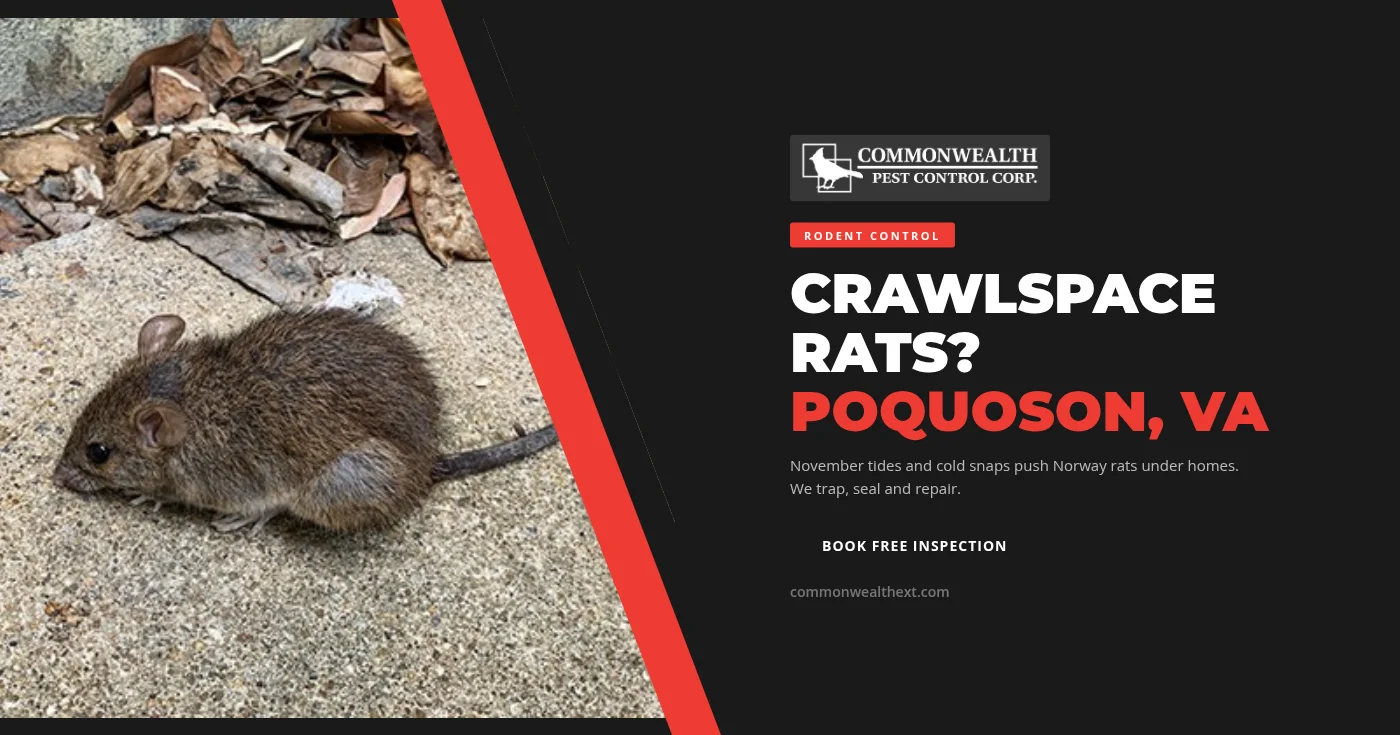
The first real cold snaps of November send Norway rats hunting for warmth. In a low-lying, marsh-ringed city like Poquoson, the crawlspace under your home is often the first dry, sheltered spot they find. If you’ve heard scratching beneath the floor at night or spotted droppings near a foundation vent, you’re not imagining things. This is the season when rodent control in Poquoson goes from a someday project to an urgent one.
Here at Commonwealth Pest, we’ve spent more than two decades crawling under homes on the Virginia Peninsula, and we see the same pattern every fall. Rising tides, falling leaves and dropping temperatures push rats out of marsh edges and yards and toward foundations. Once they’re under the house, they chew insulation, wiring and ductwork, and a few rats can become a colony quickly.
Below, we explain why Norway rats in crawlspace areas spike this time of year, how to spot the signs, why moisture matters so much and how our inspection, trapping and contractor-grade exclusion keep rats out all winter.
Why Norway Rats Head for Poquoson Crawlspaces in November
The Norway rat is the heavyweight of local rodents. The Virginia Department of Health describes a stocky body with a tail that isn’t quite as long as the head and body together, and adults weigh between 12 and 16 ounces. More importantly for this time of year, the VDH rodent control guidance notes that the Norway rat is “larger, stronger, more aggressive, and better adapted for producing young and surviving in colder climates than the roof rat.”
That cold-weather toughness is why Norway rats show up under houses as fall turns to winter. They’re ground dwellers that live low, burrow into soil and travel along foundations, so the dirt floor and framing beneath a raised home are a natural fit. A crawlspace offers nearly everything a rat needs:
- Shelter from wind, rain and frost
- Warmth from ductwork, water heaters and the living space above
- Water from condensation, small plumbing leaks and damp soil
- Nesting material in the form of insulation and vapor barrier plastic
Add nearby food from bird feeders, pet bowls and trash cans, and you have a winter home. Because a female can have several litters a year, a pair of rats that settles in during November can grow into a real colony by spring if nothing interrupts them.
How Tidal Flooding, Marsh Edges and Cold Snaps Push Rats Toward Homes
Tides, Marsh Edges and Flooded Burrows
This corner of the Peninsula is low-lying and wrapped in tidal marsh, and many properties sit in or near flood zones. Fall and early winter often bring higher “king” tides and nor’easters that push water farther up marsh edges, drainage ditches and low yards. Norway rats love to burrow in exactly those banks. When water fills their tunnels, they move to higher, drier ground, and that’s often the soil along your foundation.
No one can predict exactly which tide or storm will trigger a move, and timing varies from year to year. Still, it’s common for homeowners to notice new activity under the house shortly after a big tide or coastal storm.
Cold Snaps and Disappearing Cover
Hampton Roads typically sees its first frosts and cold snaps sometime in the second half of November. At the same time, leaves drop, gardens get cleared and summer food sources dry up. Rats that lived outdoors all summer lose both cover and food, and a vented crawlspace with gaps around pipes and doors looks very inviting.
That’s why winter rat control in Hampton Roads is really about timing. The best moment to inspect and seal is before the coldest weeks set in, or as soon as you notice the first signs.
Signs You Have Rats Under the House: Droppings, Gnawing, Burrows and Torn Insulation
Rats are mostly active at night, so many homeowners never see one. Instead, they find what rats leave behind:
- Droppings. Norway rat droppings are typically larger than mouse droppings, dark and capsule-shaped with blunt ends, often along walls, on sill plates and near entry points.
- Gnawing. Fresh chew marks on wood, vent screens, pipes, ductwork and wiring. The VDH warns that “numerous fires have been started by rats chewing through electrical wiring.”
- Burrows. Per the VDH, “burrows consist of tunnels dug below ground and are used by rodents for nesting and as a path for travel.” Look along the foundation, under porches and steps, beside AC pads and in the crawlspace soil.
- Torn or flattened insulation. Batts hanging from the subfloor, shredded vapor barrier or tunnels through insulation point to nesting.
- Rub marks and runways. Greasy smudges along joists and walls, plus packed-down paths in the soil.
- Sounds and smells. Scurrying under the floor at night, a musky odor or a pet fixated on a floor vent.
If you find droppings, don’t sweep or vacuum them dry. Public health agencies generally recommend wetting droppings and nesting material with disinfectant first to keep dust down. For heavily soiled insulation, professional removal is usually the better call.
Why Damp Crawlspaces Attract Rats and How Moisture Control Helps
Norway rats need regular access to water, and a damp crawlspace is a convenient supply. Condensation on ducts and pipes, slow leaks, standing water after heavy rain and wet soil all give rats a reason to stay.
Moisture is a constant challenge in coastal Virginia. Humid air flows through crawlspace vents, settles on cooler surfaces and soaks into insulation and framing. Over time, damp insulation sags and falls, creating ready-made nesting material. Dampness also softens wood, making sill plates and rim joists easier for rats to chew through and enlarge.
That’s why we treat moisture as part of rodent prevention, not a separate problem. Our moisture control services can include:
- Installing or replacing vapor barriers over crawlspace soil
- Crawlspace dehumidifier installation
- Drainage improvements, including French drains
- Mold and fungus treatment on framing when it’s present
A drier crawlspace is less attractive to rats and many other pests, and it protects the wood that holds your home up. It also helps exclusion work last, because repairs aren’t fighting rot from day one. When we inspect for rats, we evaluate moisture at the same time, so you get one plan for the pest and the conditions that drew it in.
Our Process for Rodent Control in Poquoson: Inspection, Trapping and Targeted Treatment
Here at Commonwealth Pest, we don’t toss bait under a house and hope for the best. Our technicians are trained through the Virginia Tech Entomology Department and the Virginia Pest Management Association, and we use Integrated Pest Management, so every step is based on what the inspection shows.
Step 1: A Thorough Inspection
We start with a free inspection. We walk the exterior looking for burrows, runways and gaps, then go into the crawlspace to check vents, access doors, sill plates, plumbing and HVAC penetrations, insulation and moisture. We map where rats enter, where they nest and how heavy the activity is.
Step 2: Trapping Inside, Bait Stations Outside
Inside the crawlspace, we lean on traps rather than loose bait, which lets us remove rats instead of leaving them to die somewhere under your floor. Placement is everything. The VDH notes that success with glue boards “depends on the correct placement of the boards,” directly in the runway and flush against the wall between harborage and feeding areas. That principle guides how we set every trap.
Outdoors, when bait makes sense, we use secured, tamper-resistant stations. The VDH recommends spacing stations every 15–30 feet for rats and notes that secured bait adds protection around children and pets.
Step 3: Follow-Up
We return to check and reset traps, remove captured rats and monitor until activity stops. Then it’s time to close the doors for good.
Kill and Repair: Sealing Vents, Sill Plates and Gaps With Contractor-Grade Exclusion
Trapping alone is a short-term fix. If the openings stay open, new rats move in. This is where we differ from most pest control companies: Commonwealth Pest is also a licensed contractor with master carpenters on our team, so we kill the pests and repair the damage.
Crawlspace Rodent Exclusion
Rats are commonly cited as squeezing through gaps around half an inch wide, so we take small openings seriously. Our crawlspace rodent exclusion work can include:
- Replacing torn or flimsy vent screens with heavy-gauge metal
- Sealing gaps around pipes, wires and HVAC lines with hardware cloth, sheet metal, steel mesh and cement-based materials rats can’t chew
- Repairing or replacing crawlspace access doors
- Closing burrow entry points along the foundation
We don’t rely on expanding foam alone, because rats can chew right through it.
Rodent Entry Point Repair and Damage Restoration
Sometimes the entry point is the damage itself: a rotted sill plate, a chewed rim joist or soft siding near grade. Our structural repair team replaces that wood instead of patching over it. We can also remove contaminated insulation, replace damaged vapor barrier and coordinate moisture fixes so sealed vents don’t trap humidity.
Buying or selling? Our termite and moisture inspections can catch rodent and moisture damage before it surprises anyone at closing.
Frequently Asked Questions About Crawlspace Rat Control in Poquoson
How do I know whether it’s rats or mice under my house?
Size is the biggest clue. Norway rats are heavy, stocky rodents, and their droppings, burrows and gnaw marks are noticeably larger than a mouse’s. Burrows in the soil along the foundation point strongly toward Norway rats. If you’re unsure, our inspection will tell you.
Why are rats in my crawlspace in November?
Usually it’s a combination of colder weather, higher fall tides that flood outdoor burrows and the loss of cover and food as yards are cleared. Your crawlspace offers warmth, water and shelter in one spot.
How do I keep rats out of a crawlspace in Poquoson, VA?
Seal entry points with durable materials, keep the crawlspace dry, store pet food and birdseed in sealed containers and keep firewood and debris away from the foundation. For lasting results, pair professional trapping with contractor-grade exclusion so new rats can’t follow.
Who repairs crawlspace vents and insulation damaged by rats?
We do. As a licensed contractor and pest control company, we can trap the rats, seal the openings and repair vents, insulation, vapor barriers and framing without you hiring a second contractor.
Schedule Rodent Control in Poquoson Before Winter Sets In
Norway rats don’t wait for spring, and neither should you. The sooner you deal with activity under the house, the less damage rats can do to insulation, wiring and wood. Effective rodent control in Poquoson comes down to finding how rats get in, removing the ones already there and fixing the conditions that invite them back.
Commonwealth Pest is a second-generation, family-owned business that has served homeowners from our home base in Newport News since 1999. We treat every customer the way we’d want to be treated, and you’ll always have a direct line to the family behind the work. Contact us to schedule your free inspection, and let’s get your crawlspace sealed before the coldest weeks arrive.
Who Can Get Rats Out of My Crawlspace and Fix the Damage They Left Behind?
We can. Most pest control companies stop once the rats are trapped, but we’re also a licensed contractor with master carpenters on our team. That means we handle the whole job, from the first inspection to the last repaired board, so you never have to coordinate a second company.
Here’s what our crawlspace rodent work typically includes:
- Free inspection of your foundation, vents, crawlspace doors, insulation and moisture levels
- Targeted trapping under the house and secured, tamper-resistant bait stations outside when appropriate
- Contractor-grade exclusion using heavy-gauge metal, hardware cloth and cement-based materials rats can’t chew
- Structural repair of rotted sill plates, rim joists and damaged framing
- Moisture control such as vapor barriers, dehumidifiers and drainage improvements
Our technicians are trained through the Virginia Tech Entomology Department and the Virginia Pest Management Association, and we follow Integrated Pest Management principles. That means targeted, science-based treatment rather than heavy-handed chemical use, which gives families and pets added peace of mind.
We’re a second-generation, family-owned business that has been protecting homes since 1999, and we treat every customer the way we’d want to be treated. Explore our full range of pest control services, or reach out to us to book your free inspection and get your crawlspace sealed up for winter.