
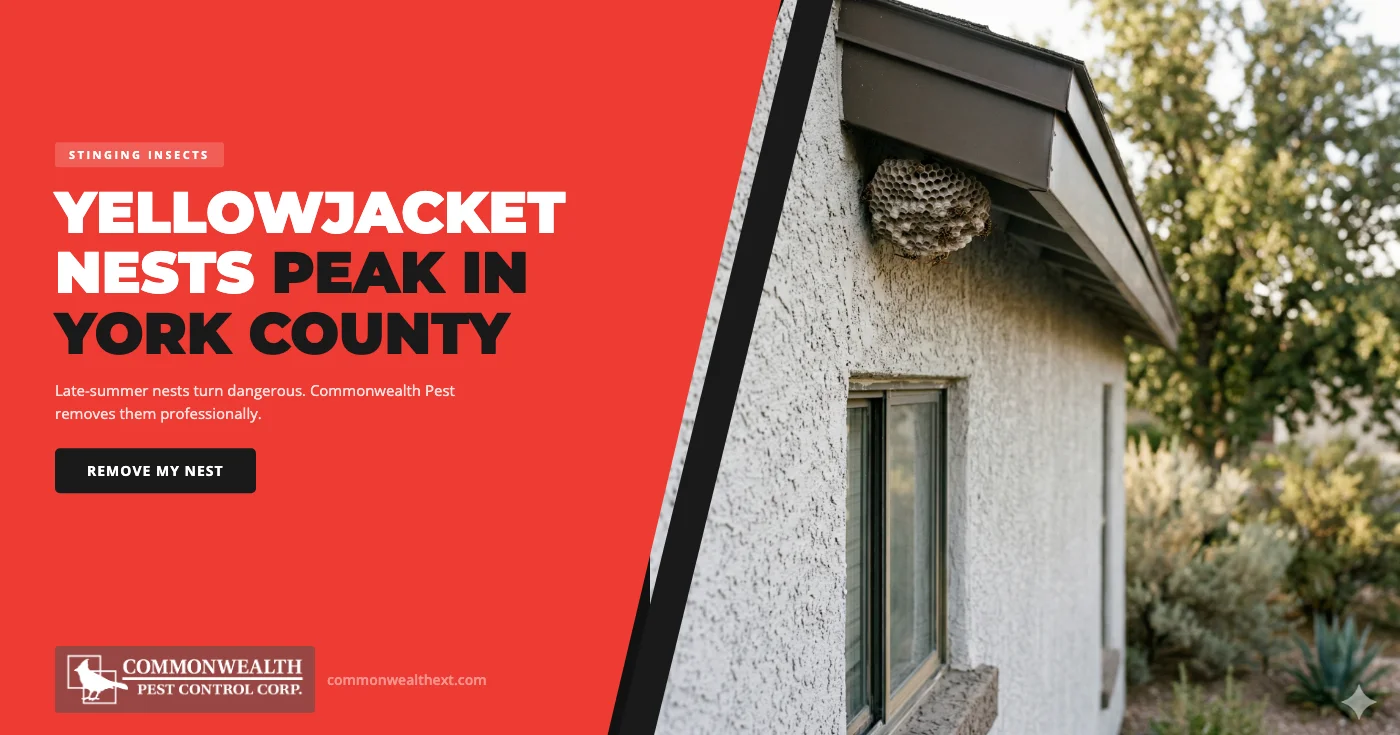
Late August in York County is when things change for local wasps. Colonies that spent the spring quietly building have grown into thousands of workers, natural food sources are drying up, and the mood around a York County yellowjacket nest turns from indifferent to actively defensive. Every year we get the same calls from Grafton, Tabb, Yorktown, and Seaford — a homeowner mowing near the shrubs is suddenly stung eleven times. Once you understand the biology, professional yellowjacket control in York County, VA becomes easier to think about clearly.
Why Yellowjacket Colonies Peak in Late Summer in York County, VA
The eastern yellowjacket (Vespula maculifrons) — the species behind most stinging incidents across the Hampton Roads corridor — runs on an annual life cycle. Every colony you encounter in York County right now started in April with a single overwintered queen who emerged from beneath leaf litter, found a suitable cavity, and laid the first few eggs herself.
By late July the colony has hundreds of workers. By mid-August, thousands. By early September, the largest York County yellowjacket nests hold four to five thousand individuals, and in a warm coastal year we occasionally see colonies past that. The sheer number of workers defending the nest is now several orders of magnitude higher than it was in May.
Colony size is only half the aggression story. Through summer, workers hunted caterpillars and flies to feed the larvae — a protein-heavy focus that kept them oriented on prey rather than on people. In late August, as larval production winds down, the colony's protein need collapses and workers shift almost entirely to carbohydrate scavenging. That's why yellowjackets now seem obsessed with soda cans, hummingbird feeders, and grill drippings in a way they weren't in June.
Cooler evenings and disturbances compound the shift. Mowing near an in-ground yellowjacket entrance triggers a full-colony defensive response from a nest that would have been much more tolerant of the same disturbance eight weeks ago. Once one yellowjacket stings, she releases an alarm pheromone that recruits the rest of the colony to attack as a coordinated group. That's why so many York County stings come in clusters of a dozen or more — the second sting isn't a coincidence, it's a signal.
Where Yellowjackets Build Nests Around York County Homes
York County's mix of wooded lots, older neighborhoods, wetland edges, and coastal soil gives yellowjackets an unusually rich range of nesting options. On any stinging insect control in York County call, our first job is usually to figure out where the nest actually is — because the wasps a homeowner sees at the deck rail may be entering the ground twenty feet away. The most common nest sites we find:
- Ground burrows. Eastern yellowjackets favor pre-existing holes in the soil — abandoned chipmunk burrows, mole runs, rotted-out root voids. The entrance is usually a small hole in a lawn edge or mulch bed, and homeowners often walk past it dozens of times before noticing.
- Wall voids and soffits. On older York County homes — including many properties near Yorktown Battlefield — colonies establish inside wall voids, entering through siding gaps, gable vents, or a hole where a fixture used to be. High-risk because the nest can grow to full size before anyone realizes the buzzing behind a bedroom wall isn't a bee.
- Under porches and decks. Dry, sheltered voids under wood decks and porches are ideal cavity habitat. Colonies here often go undetected until fall yard cleanup.
- Sheds, garages, and outbuildings. Any structure with stable interior temperature and a small entry point is a candidate. We regularly pull nests the size of a beach ball out of shed rafters in the Grafton and Tabb areas.
- Landscape features. Retaining walls, brick piers, and dry-stacked stone create small cavities that yellowjackets colonize readily.
Visible traffic often doesn't match the entry point. A colony inside a soffit may send workers a hundred feet across a yard before they're noticed. Reading flight lines correctly — following workers back toward the entrance rather than watching where the sting occurred — is a skill our technicians develop through hundreds of York County jobs.
Signs of a Dangerous Yellowjacket Nest Near Your Property
Not every yellowjacket sighting means you have an active nest. A single foraging worker at a kitchen window in August is probably passing through. What we're looking for — and what York County homeowners should watch for — are signs of an established colony within short flight distance.
- Consistent, directional traffic. Yellowjackets returning to a nest fly in a straight line. If you see the same flight pattern from the same spot over an afternoon, follow it visually. The entrance is at the end of that line.
- Ground-level activity in a specific spot. Repeated wasp activity within a two- or three-foot area of a lawn edge, mulch bed, or under a shrub almost always indicates a ground nest. Do not investigate closer.
- Buzzing inside walls or ceilings. A continuous low buzz behind drywall, especially near a soffit, is a red flag for a colony in the void. Do not tap or knock on the wall — vibration is a defensive trigger.
- Wasps entering and exiting a single point. A steady stream of workers using one small hole in siding, a gable vent, or a foundation crack is the clearest sign of an established colony.
- Multiple stings from a single approach. If a family member, pet, or landscaper is stung more than once in the same location within a few minutes, that spot has an active nest.
A York County yellowjacket nest close to a doorway, high-traffic yard area, HVAC unit, or child play zone becomes more dangerous every week the colony continues to grow. About three percent of adults have some level of allergic reaction to wasp venom, and a subset of those are severe enough to be life-threatening. Even without an allergy, a coordinated attack from a mature colony can deliver enough venom to require medical attention.
Why DIY Yellowjacket Removal Is Risky for York County Homeowners
We understand the appeal of the hardware-store wasp spray. It's affordable, it's local, and it looks like it should work. Every August we visit York County homes where a homeowner tried the DIY route first, and we come away with a consistent pattern of what tends to go wrong.
The most common failure is partial treatment. Aerosol wasp spray knocks down the workers currently outside the nest, but rarely penetrates deep enough into a ground burrow or wall void to reach the queen, developing larvae, and workers still inside. Within twenty-four to forty-eight hours, the colony recovers — and the survivors are now defensive, alarm-primed, and much more likely to strike anyone approaching the entrance for the next week. The nest didn't get worse; the response threshold got lower.
Second: most DIY incidents happen at night, when homeowners assume the colony is dormant. A mature nest still has hundreds of workers awake inside, and any vibration triggers a defensive response from workers that will pursue a flashlight beam without hesitation. Approaching a ground nest with a spray can and a headlamp is one of the higher-risk things a homeowner can do in a York County yard.
Third: for wall-void colonies, the wrong treatment can drive wasps deeper into the structure — and occasionally into the living space through electrical outlets, recessed lighting, or HVAC returns. This is what we're most concerned about when a homeowner mentions they've already tried spraying.
For a small paper wasp nest on a low eave in May, a homeowner can reasonably handle it. For a mature, thousand-worker York County yellowjacket nest in late August, the math on risk, effectiveness, and long-term outcome favors calling a professional every time.
Other Stinging Insects to Watch for in York County This August
Yellowjackets get most of the attention in late summer, but they aren't the only stinging insects that peak now across Hampton Roads. The treatment for one species isn't always right for another, and misidentification is one of the more common reasons DIY attempts go sideways.
- Bald-faced hornets (Dolichovespula maculata). Despite the name, these are technically yellowjackets — black-and-white cousins of Vespula. They build the large gray paper football nests that hang from tree branches and eaves, colonies also peak in August and September, and they're notoriously defensive of their aerial nests.
- Paper wasps (Polistes species). Smaller open-comb nests under eaves, in mailboxes, in playhouse rafters. Less aggressive than yellowjackets but sting readily when the nest is disturbed. Late-summer paper wasp colonies can still be several dozen individuals strong.
- European hornets (Vespa crabro). The only true hornet in the region. Larger, brown-and-yellow, and unusual in that they forage at night — sometimes drawn to porch lights, which alarms homeowners who don't expect an insect that size at their window after dark.
- Cicada killers. These enormous ground-nesting wasps are common in York County during July and August. Despite their size, they are essentially non-aggressive toward humans, and we routinely recommend leaving them alone unless a nest is in a problematic location.
- Ground-nesting bees. Late-summer digger bees and sweat bees appear in bare lawn patches and can be mistaken for yellowjackets. These are important native pollinators and do not warrant treatment in most residential situations.
Getting identification right isn't academic. It shapes whether we treat at all, what product we use, and how we approach the nest. Homeowners who assume every yellow-and-black insect is a yellowjacket will sometimes call us out for a colony that turns out to be beneficial pollinators the family would rather keep.
How Commonwealth Pest Handles Yellowjacket Nest Removal in York County
Every yellowjacket control in York County, VA call starts with a phone conversation about what the homeowner has been seeing — where the wasps are entering, how many, whether anyone has been stung, and whether children or pets have been in the affected area. On site, our technicians follow flight lines to pinpoint the entrance, distinguish between yellowjacket species and lookalikes, and assess how far the nest has progressed. That assessment shapes everything that follows — treatment method, timing, and follow-up. Depending on nest type and location, our York County yellowjacket treatment typically involves one or a combination of the following:
- Direct-injection dust treatment. For ground nests and wall-void colonies, insecticidal dust delivered directly into the entrance is the most effective approach. Workers carry the material back into the nest, distributing it throughout the colony and reaching the queen and developing brood. That's what makes professional treatment fundamentally different from a surface spray.
- Targeted aerosol for aerial nests. For bald-faced hornet or paper wasp nests in reachable locations, a targeted aerosol under the right conditions brings the colony down without the escalation risk of a poorly-timed DIY attempt.
- Full nest removal after knockdown. Once the colony has been neutralized, we return to remove the physical nest whenever access permits. An abandoned nest inside a wall void can attract secondary pests (dermestid beetles, mice) that feed on the dead larvae.
- Entry-point sealing. Once the colony is gone, we walk the property and identify the openings that made the site attractive. Long-term stinging insect control in York County is as much about closing entries as it is about treating existing nests.
- Timing. Treatments work best at dawn or dusk when most of the colony is inside the nest. Our schedule flexes to catch those windows on active jobs.
To learn more, visit our Stinging Insect Control page or explore our Pest Control Blog for guidance across the Hampton Roads region. For homeowners who want to understand the biology behind what they're seeing, Virginia Cooperative Extension maintains a public reference on wasp and yellowjacket identification specific to Virginia.
We serve York County, Newport News, Hampton, Poquoson, and the surrounding Hampton Roads communities. To learn more, visit Commonwealth Pest Control. A mature York County yellowjacket nest is not a situation to hesitate on — every week now carries more risk. If you're seeing consistent yellowjacket activity in one part of your property, the right next step is a professional inspection this week.