
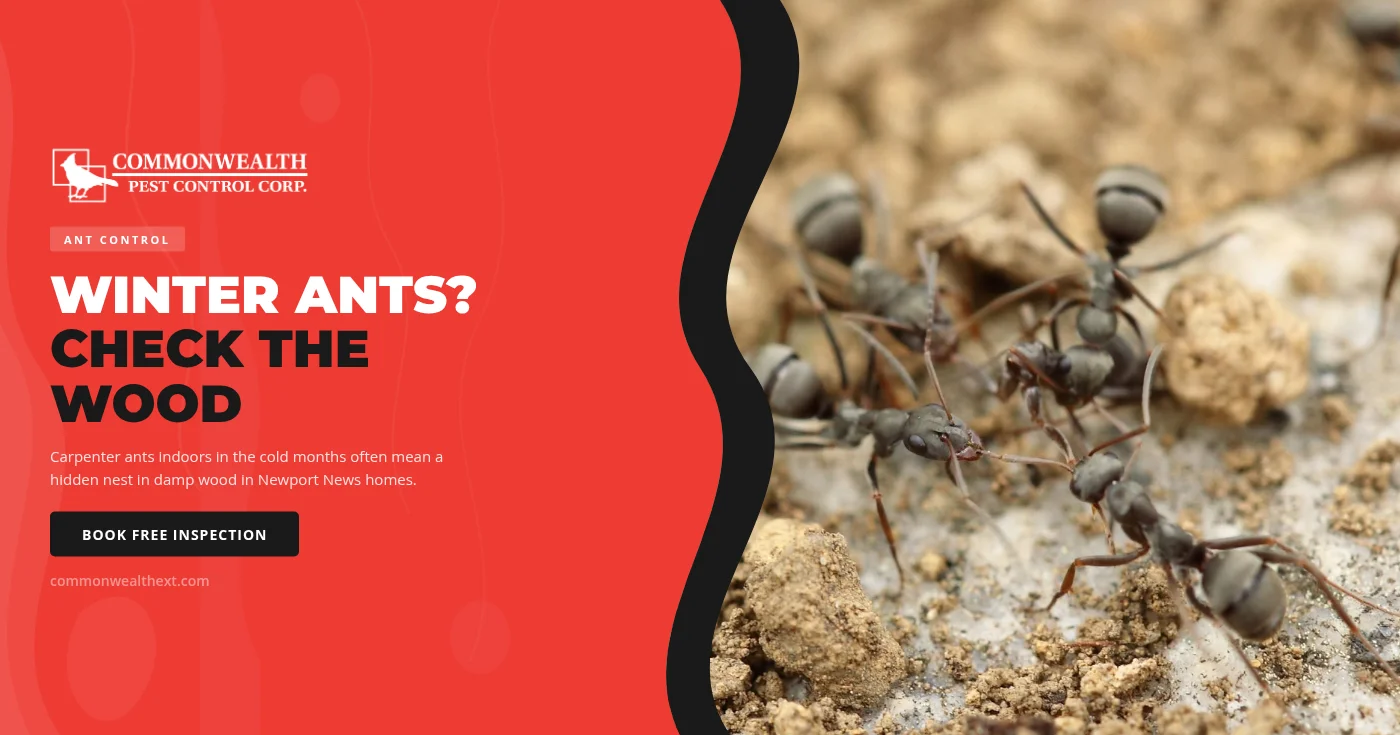
It’s November, the heat just kicked on, and a trail of large black ants is marching along your kitchen windowsill. Most people assume the ants simply came inside to escape the cold. If you’ve been searching for carpenter ant control Newport News VA homeowners can rely on, here’s the hard truth: ants trailing indoors this late in the year usually point to a colony already living inside your home, tucked into wood that has gotten wet.
Here at Commonwealth Pest, we’ve been protecting homes across Newport News since 1999, and carpenter ants in winter are one of the clearest warning signs we see. These ants don’t eat wood, but they hollow it out to nest, and they almost always choose wood that moisture has already softened. That makes the ants a symptom of a bigger problem: a leak, a damp crawlspace or rot you haven’t found yet.
In this post, we’ll explain why cold-weather ant activity matters, how to tell carpenter ants from termites, where hidden nests tend to be, and how our “kill and repair” approach treats the colony, fixes the moisture and repairs the damaged wood, all with one team.
Why Seeing Carpenter Ants Indoors in November Is a Red Flag in Newport News
Carpenter ants follow the seasons. Outdoor colonies, often in stumps, dead trees or old landscape timbers, slow down and go dormant as temperatures drop. Inside a heated home, though, a colony nesting in the walls can stay active all winter.
Extension entomologists, including the team at Penn State Extension, generally note that carpenter ants seen indoors during late winter, or winged swarmers emerging inside, strongly suggest a nest within the structure. Our November weather is milder than in northern states, so on a warm afternoon a few workers may still forage in from outside. Even so, if you’re seeing ants regularly once the heat is on, an indoor nest is likely.
Signs That Point to an Indoor Nest
- Ants trailing at night along baseboards, countertops or plumbing lines
- Winged ants appearing inside, especially near windows
- Small piles of sawdust-like debris, called frass, beneath trim, walls or crawlspace framing
- A faint rustling or crinkling sound inside walls or hollow doors
- Large black ants, roughly ¼ to ½ inch long, near kitchens and bathrooms
The most common structural species in Virginia is the black carpenter ant, Camponotus pennsylvanicus. Its workers vary a lot in size, so a mix of big and small ants in one trail is normal.
How Coastal Humidity and Damp Crawlspaces Create Perfect Indoor Nest Sites
Our corner of Virginia is surrounded by water, from the James River to Hampton Roads and the Chesapeake Bay, and that humid climate shows up inside homes. Many Peninsula houses are built over vented crawlspaces that pull in muggy summer air. When that air meets cooler framing, condensation forms, and sill plates and floor joists can stay damp well into fall.
Add a high water table in low-lying neighborhoods, plus leaks left behind by fall nor’easters and the tail end of hurricane season, and you have exactly what carpenter ants want: softened, moist wood that’s easy to excavate.
The Parent Colony and Its Satellites
Carpenter ants often build in stages. The parent colony, with the queen, may start outdoors in a rotting stump or tree. As it grows, it can send workers to form satellite colonies in damp wood inside your home. Most extension guides say it takes several years, often cited as three to six, before a parent colony produces winged swarmers. So if swarmers show up indoors, the colony has likely been around for a while.
Once established in wet wood, colonies may also expand into nearby sound wood. That’s why a carpenter ant nest in house framing is never just a pest problem. It’s a moisture problem and, sometimes, a structural one.
Carpenter Ants vs. Termites: Telling the Signs Apart
Eastern Virginia sees heavy termite pressure, so confusing the two is a real risk. Treatments differ, and the wrong one wastes time while damage continues. Here’s how carpenter ants vs termites compare.
Body Shape and Wings
- Carpenter ants: pinched, wasp-like waist; elbowed antennae; front wings longer than the hind wings
- Termites: thick, straight waist; straight, beaded antennae; four wings of equal length
Damage and Debris
Carpenter ant galleries look smooth, clean and almost sanded. Termite galleries are packed with mud or soil. When it comes to carpenter ant frass vs termite droppings, ant frass looks like coarse sawdust mixed with insect parts and gets pushed out of the wood into small piles. Subterranean termites, the dominant species here, typically leave mud tubes along foundations rather than sawdust piles.
Timing
Eastern subterranean termites usually swarm in spring, roughly March through May. Winged insects indoors in November or December are more likely to be carpenter ants, though only a close inspection can confirm it. Our Certified WDI Inspectors check for both, so you get a clear answer either way. The Virginia Cooperative Extension also publishes helpful fact sheets on both pests.
Where Our Technicians Look for Hidden Carpenter Ant Nests
Knowing how to find a carpenter ant nest inside walls takes patience and a solid understanding of ant biology. Our technicians, trained through the Virginia Tech Entomology Department and the Virginia Pest Management Association, follow the moisture and the ants.
Common Hiding Spots
- Crawlspace sill plates and band boards, especially along damp foundation walls
- Floor joists under bathrooms, kitchens and laundry areas
- Window frames and sills where caulk or flashing has failed
- Wall voids around leaky tubs, showers and toilets
- Porch, deck and doorway framing that soaks up rainwater
- Attic framing near chimneys and roof leaks
We look for frass piles, ant trails (often busiest after dark), wet or soft wood, and moisture readings that don’t look right. We also check the yard for parent colonies in stumps, firewood stacks and trees touching the roofline.
The goal is to map where the colony actually lives, not just where the ants show up. A trail on your kitchen counter might lead back to a bathroom wall or a crawlspace beam several rooms away, and treating the wrong spot only buys time.
How Professional Carpenter Ant Control in Newport News VA Eliminates the Colony
Grabbing a can of store-bought spray is tempting, but sprays that only kill foraging workers rarely reach the colony. The queen and brood stay hidden in the wood, and the colony keeps going, sometimes splitting into new satellites.
As an ant exterminator Newport News families trust, we use Integrated Pest Management (IPM), a science-based approach that focuses on biology and targeted treatment instead of heavy chemical use. Depending on what the inspection finds, that may include:
- Direct nest treatment: applying insecticidal dust or foam into galleries and wall voids where the colony lives
- Slow-acting baits: workers carry bait back to share with the queen and brood
- Outdoor source treatment: addressing parent colonies so new satellites don’t form
Baits typically take days to a few weeks to work through a colony, so you may see some activity before it tapers off. That’s normal. We place treatments only where they’re needed, which keeps them targeted and gives families and pets peace of mind.
Treating the ants is only step one. If the damp wood stays damp, new ants will eventually find it.
Fixing the Moisture Problem So Carpenter Ants Don't Come Back
Extension guidance consistently recommends correcting moisture as part of carpenter ant control, and it’s where we focus much of our attention. Through our moisture control services, we address the root cause instead of just the symptoms. Depending on your home, that may include:
- Crawlspace dehumidifier installation to keep humidity in check year-round
- Vapor barriers to limit ground moisture rising into framing
- French drains and grading improvements to move water away from the foundation
- Tracking down plumbing, window and roof leaks feeding the damp wood
- Mold and fungus control where wood has started to decay
Drying out the crawlspace does more than discourage ants. It also makes your home less inviting to termites, protects your floor system and can improve the air quality in your living space.
Do carpenter ants mean you have water damage? Not always, but often enough that we treat every infestation as a reason to check. In our humid climate, a crawlspace that feels fine in January may be dripping with condensation by July, so we look at how your home handles moisture all year, not just on inspection day.
Repairing Damaged Sill Plates, Joists and Window Frames With One Company
Here’s where we’re different from most pest control companies. Commonwealth Pest is also a licensed contractor, with master carpenters in-house. Many companies can kill the insects, but then you’re left searching for a second contractor to fix the wood. We handle carpenter ant damage repair ourselves through our structural repair services. That “kill and repair” approach means:
- One inspection that covers pests, moisture and wood damage
- One team coordinating treatment, drying and repairs
- Replacement or reinforcement of damaged sill plates, joists, band boards and window framing
- No juggling schedules between a pest company and a carpenter
Carpenter ants generally damage wood more slowly than termites, but long-running colonies in wet framing can still cause real harm. How much depends on the colony’s size and how long it’s been there. Catching it early is always easier on your home and your wallet.
Buying or selling? Our termite and moisture inspections can flag ant activity and hidden moisture damage before it holds up a closing.
Frequently Asked Questions About Carpenter Ant Control in Newport News, VA
Why are carpenter ants in my house in November in Newport News?
Most often, a satellite colony is nesting in damp wood inside your home, and your heating system keeps it active. On a mild day a few ants may still wander in from outside, but steady indoor activity in cold weather usually points to an indoor nest.
Will store-bought ant spray get rid of carpenter ants?
Usually not. Sprays kill the workers you see but rarely reach the queen and brood inside the wood. Finding and treating the nest, then fixing the moisture behind it, gives you a far better result.
Does homeowners insurance cover carpenter ant damage?
In many cases insect damage isn’t covered, but policies vary. Check your own policy or ask your agent to be sure.
How much does a carpenter ant inspection cost?
Our inspections are free. Treatment pricing depends on your home’s location, square footage and the time needed, so we’ll walk you through options once we see what’s going on.
Get Expert Carpenter Ant Control in Newport News VA This Winter
Ants in the house in November aren’t just a nuisance. They’re often your home’s way of telling you there’s damp, damaged wood somewhere you can’t see, and the sooner you find the nest, the less work it takes to fix. Here at Commonwealth Pest, we’ve been a family-owned business since 1999, with more than 25 years of experience serving the Peninsula, including Hampton, Poquoson and York County. We’ll treat the colony, solve the moisture problem and repair the wood, all under one roof.
If you need carpenter ant control Newport News VA homeowners can count on, schedule your free inspection today and let our team find the source before spring.
Who Can Get Rid of Carpenter Ants and Fix the Wood They Damaged?
We can. Here at Commonwealth Pest, we’re a family-owned, second-generation business that has been caring for local homes since 1999, and we’re built to handle the whole carpenter ant problem, not just the part you can see.
Most pest companies stop once the ants are gone. We go further, because we’re also a licensed contractor with master carpenters on our team. When we find a carpenter ant colony, we:
- Find the nest: our technicians, trained through the Virginia Tech Entomology Department and the Virginia Pest Management Association, trace the ants back to where the colony actually lives.
- Treat the colony: we use Integrated Pest Management with targeted nest treatments and baits that reach the queen and brood.
- Fix the moisture: through our moisture control services, we install dehumidifiers, vapor barriers and drainage solutions that keep wood dry.
- Repair the damage: our structural repair team replaces or reinforces sill plates, joists and window framing.
That means one inspection, one team and one plan, with no coordinating between a pest company and a separate carpenter. Our Master Tech and Certified WDI Inspector credentials mean we can tell carpenter ants and termites apart with confidence, so you get the right treatment the first time.
We treat every customer the way we’d want our own family treated. If you’re seeing ants this winter, reach out to us for a free inspection and let us get to the root of it.